



Yes, Indian students can study in UK without IELTS in 2026, but it does not mean English proof is optional. UK universities and visa rules still require proof that you can read, write, speak and understand English. The difference is that many universities may accept alternatives such as a Medium of Instruction (MOI) certificate, strong Class 12 English marks(60%+), other English tests, university interviews or pre-sessional English courses.
For Indian students, this can save time, reduce test stress and make the UK admission process easier. However, every university and course has its own English language policy, so you must check requirements before applying. UK Student visa rules also require English ability and a higher education provider can assess English for degree-level study if it meets the required standard.
This guide explains how to study in the UK without IELTS, which universities may consider IELTS alternatives, what documents you need and how to avoid common mistakes during admission and visa preparation.
Key Takeaways
- You can study in the UK without IELTS if your university accepts another valid proof of English.
- IELTS alternatives may include MOI, Class 12 English scores, TOEFL, PTE, LanguageCert, Trinity ISE, internal university tests or pre-sessional English.
- UK Student visa applicants still need to meet English language requirements.
- For degree-level study, the required English level is generally equivalent to CEFR B2.
- Universities decide their own English assessment method, but it must meet Home Office minimum standards.
- Indian students should prepare MOI, transcripts, academic documents, passport, SOP, LORs and financial proof early.
- Always confirm requirements on the official university course page before applying.
Can You Study in UK Without IELTS in 2026?
You can study in UK without IELTS in 2026 if your chosen university that accepts an alternative English language proof and confirms that you meet the required English standard.
In simple words, IELTS is only one way to prove English proficiency. It is not always the only option.
According to UK Student visa guidance, students must prove they can read, write, speak and understand English. For degree-level study or above, the required level is equivalent to CEFR B2 for below-degree-level courses, it is generally CEFR B1.
UKCISA also explains that your student sponsor will tell you how it will assess your English,=and the method may vary depending on the university and course.
Top UK Universities That May Consider IELTS Alternatives
This is not a guaranteed “no IELTS university list.” English rules change by course, level, intake and applicant profile. Always check the official university page before applying.
|
University |
Possible IELTS Alternative |
Best For |
Important Note |
|
University of Bath |
English-medium Indian degree + official proof, subject to conditions |
Postgraduate taught courses |
May require evidence of English-medium instruction and Class 12 English scores. |
|
University of Leicester |
Education in English, selected Indian degrees, other tests |
UG and PG applicants |
SELT may not be required for degree courses, but English and visa rules still apply. |
|
University of Gloucestershire |
MOI/EPL for eligible Indian students from top NIRF universities |
Indian graduates |
Considers MOI/EPL from students who studied at eligible Indian universities. |
|
Nottingham Trent University |
Accepted tests and country qualifications |
Students with alternative test scores |
Does not generally accept MOI letters unless listed under its policy. |
|
University of Surrey |
Sufficient evidence in exceptional circumstances |
Case-by-case applicants |
May assess additional evidence depending on course and profile. |
Accepted Alternatives to IELTS for UK Admission
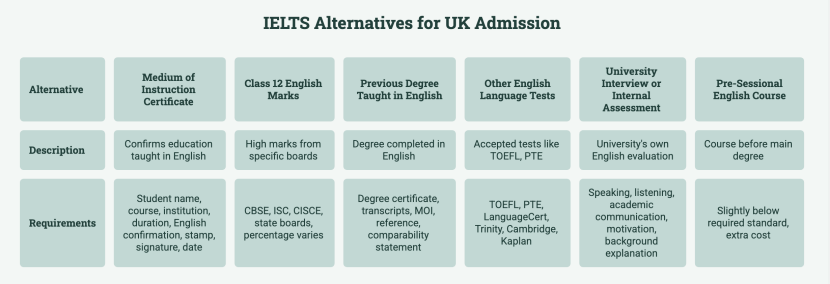
1. Medium of Instruction Certificate
An MOI certificate confirms that your previous education was taught in English.
For Indian students, MOI is one of the most common IELTS waiver documents. It is usually issued by your school, college or university on official letterhead.
A strong MOI should mention:
- Student name
- Course or qualification completed
- Institution name
- Duration of study
- Confirmation that the course was taught and assessed in English
- Official stamp and signature
- Date of issue
2. Class 12 English Marks
Some UK universities may accept high English marks from CBSE, ISC, CISCE or selected state boards. The required percentage varies by university and course.
3. Previous Degree Taught in English
If your bachelor’s or master’s degree was taught in English, some universities may consider this as proof. You may need:
- Degree certificate
- Transcripts
- MOI letter
- Academic reference
- Statement of comparability, where required
4. Other English Language Tests
Universities may accept tests such as:
- TOEFL
- PTE
- LanguageCert
- Trinity
- Cambridge English
- Kaplan Test of English, where accepted
5. University Interview or Internal Assessment
Some universities may conduct their own English interview or assessment. This is usually used to check:
- Speaking confidence
- Listening ability
- Academic communication
- Motivation for the course
- Ability to explain your background in English
6. Pre-Sessional English Course
If your English level is slightly below the required standard, the university may offer a pre-sessional English course before your main degree.
The British Council notes that some universities offer pre-sessional English courses when students do not meet English requirements before starting, though these usually cost extra.
Common Mistakes Indian Students Should Avoid When Applying Without IELTS
Many Indian students believe that getting an IELTS waiver makes the UK admission process simple, but small mistakes can still delay applications or affect visa approval. To study in the UK without IELTS, you must submit the right English proof, check university specific rules and make sure your admission documents support your Student visa process.
- Thinking IELTS waiver means no English requirement: IELTS may not be compulsory, but you still need valid proof of English proficiency.
- Submitting a weak MOI letter: A Unclear Medium of Instruction letter may be rejected. It should clearly mention that your course was taught and assessed in English.
- Ignoring course-level English requirements: English requirements can vary by course. Fields like nursing, law, education, medicine, psychology and research programs may have stricter rules.
- Trusting random university lists online: Many online lists are outdated. Always verify IELTS waiver rules on the official university website before applying.
- Overlooking UK Student visa requirements: Admission and visa approval are connected. Your university must confirm your English eligibility and issue a valid CAS for the visa process.
An IELTS waiver can make your UK admission journey easier, but only if your English proof, university requirements and visa documents are fully aligned.
Conclusion
Studying in the UK without IELTS in 2026 is possible for many Indian students, but it requires careful planning. You must prove your English ability through accepted alternatives such as MOI, previous English-medium education, Class 12 English marks, other English tests or a university assessment.
The safest approach is to shortlist universities based on your course, confirm English requirements on official pages, prepare documents early and make sure your CAS and visa process are aligned. If you are unsure, getting guidance from an experienced study abroad consultant can help you avoid delays, rejections and missed intakes.