
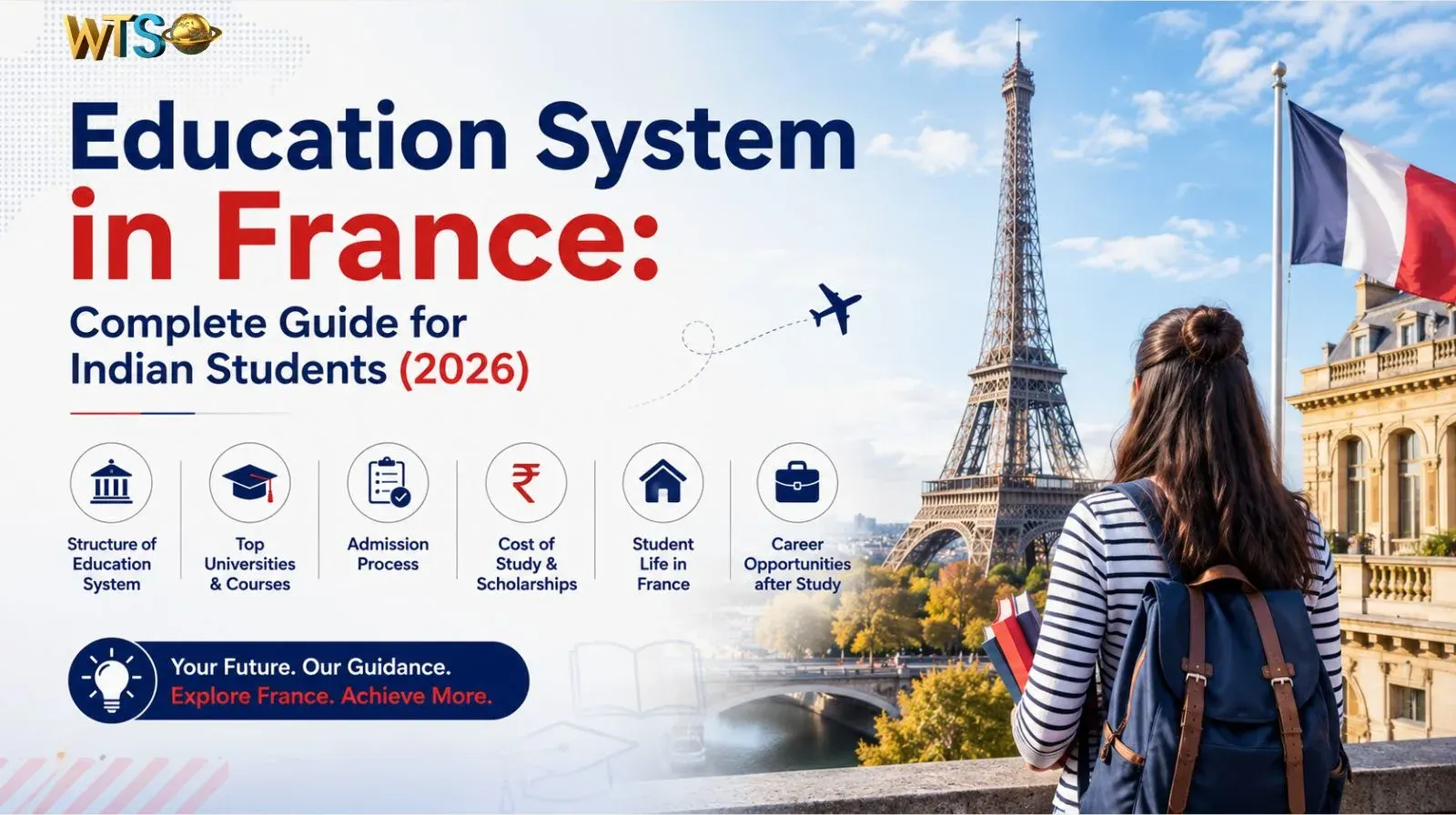
France has one of the oldest and most structured education systems in Europe and it's one of the reasons the country continues to attract thousands of Indian students every year who choose to study in France. But before you decide which university or course to apply for, it's important to understand how schooling and higher education work in France, as the structure is quite different from what we follow in India.
In this guide, we're breaking down the entire education system in France in the simplest way possible, from primary school to a doctorate degree, while also comparing it with education systems in the US, UK and Germany. Whether you're planning to study in France for a bachelor's, master's, or PhD, understanding the French education system will help you make informed decisions. If you're an Indian student trying to figure out where you'd fit into this system, our counsellors at WTS Study Abroad Consultant can help map your academic background to the right French program. As you read on, we'll also highlight where expert guidance can make your study in France journey smoother and more successful.

What Is the Education System in France?
The education system in France is centrally managed by the Ministry of National Education and the Ministry of Higher Education, Research and Innovation. Unlike India, where state boards and central boards run in parallel, France follows one national curriculum across the country, with minor variations for private and international schools.
Education is compulsory for children aged 3 to 16 and the system is broadly divided into four stages: pre-primary, primary, secondary and higher education. Public education is free at the school level and heavily subsidised at the university level, which is a big reason France remains more affordable than the US or UK for degree-seeking students. Roughly 90% of students in France attend public institutions, with the remaining share studying in private or semi-private schools that still follow the same national framework.
Structure of the French Education System: Stages Explained
Before going into each stage in detail, here's a quick snapshot of how the France education system is structured by age and level:
|
Stage |
French Name |
Age Group |
Duration |
|
Pre-Primary |
Maternelle |
3–6 years |
3 years |
|
Primary |
École Élémentaire |
6–11 years |
5 years |
|
Lower Secondary |
Collège |
11–15 years |
4 years |
|
Upper Secondary |
Lycée |
15–18 years |
3 years |
|
Higher Education |
Université / Grande École |
18+ years |
3–8 years (Licence to Doctorat) |
This is the framework you'll see referenced throughout the rest of this guide, so it's worth bookmarking this table if you're comparing it against the Indian schooling structure.
Pre-Primary & Primary Education in France (Maternelle & École Élémentaire)
Schooling in France typically begins with maternelle, which is nursery-level education for children aged 3 to 6. It isn't just daycare; it's an actual part of the formal education system in France and focuses on language development, social skills and early motor skills.
After maternelle, children move into école élémentaire, or primary school, from ages 6 to 11. This stage is split into five year groups: CP, CE1, CE2, CM1 and CM2. The focus here is on reading, writing, basic mathematics and introducing a foreign language (usually English) from CE1 onwards. By the end of CM2, students are expected to have a solid grounding before stepping into secondary school.
Secondary Education in France: Collège (11–15)
Once a student finishes primary school, they enter collège the French equivalent of middle and early high school. This covers four years, referred to in reverse order: 6e, 5e, 4e and 3e (roughly matching grades 6 to 9 in India).
At the end of collège, students sit for the Brevet des Collèges, a national exam that assesses their readiness for the next stage. It's not as high-stakes as the Baccalauréat, but it's still an important checkpoint in the French education system and results influence which stream a student is guided into at the lycée level.
Secondary Education in France: Lycée & the Baccalauréat (15–18)
This is where the French education system starts to genuinely diverge from India's. At age 15, students enter lycée for three years and they choose between three tracks:
- Général – for students planning to go to university
- Technologique – a mix of academic and applied/technical learning
- Professionnel – vocational training aimed directly at employment
At the end of lycée, students take the Baccalauréat (or "Bac") a national exam similar in weight to India's Class 12 boards, but it doubles as the primary university entrance qualification. Since the 2021 reform, the Bac Général no longer has fixed streams like Science or Commerce; instead, students pick specialisation subjects, giving them more flexibility than the earlier system.
Higher Education in France: How the System Works
Higher education in France runs on the LMD system: Licence, Master, Doctorat, which is aligned with the European Bologna Process. This makes French degrees easily recognised and transferable across the EU and increasingly across the world.
Here's how the three cycles break down:
- Licence – 3 years (equivalent to a Bachelor's degree), 180 ECTS credits
- Master – 2 years, 120 additional ECTS credits (300 total)
- Doctorat – 3+ years of research-based study
ECTS (European Credit Transfer System) is central to higher education in France; every course carries a credit value and students need a set number of credits to move to the next year or graduate. For Indian students used to a percentage or CGPA-based system, this credit structure takes a bit of getting used to, which is exactly the kind of thing our team at WTS Study Abroad Consultant walks students through during profile evaluation.
The France University System: Universities vs Grandes Écoles
One thing that confuses a lot of applicants is that the france university system isn't just "universities." There are two parallel tracks:
|
Feature |
Universities |
Grandes Écoles |
|
Entry Method |
Parcoursup / direct application |
Competitive entrance exam (concours) |
|
Focus |
Broad academic programs |
Specialised (engineering, business, admin) |
|
Cost |
Low, government-subsidised |
Higher, especially private business schools |
|
Examples of Fields |
Arts, science, law, medicine |
Engineering, management, public policy |
|
Prestige Factor |
Strong for research & academics |
Extremely high for employability in France |
Universities are open to a wider range of students and cover almost every discipline, while Grandes Écoles are smaller, highly selective institutions historically producing France's engineers, executives and civil servants. Both fall under the same national education framework, but the entry path and campus experience are quite different.
Read More: Top Universities in France 2026: Rankings, Fees & Admission Guide for Indian Students
Grading & Academic Calendar in the French System
France uses a 0 to 20 grading scale at every level, where 10/20 is generally considered a passing grade and anything above 16/20 is considered excellent French professors are traditionally strict with marks, so don't be alarmed if scores look lower than what you're used to in India.
The academic year usually runs from September to June, split into two semesters, with assessments happening through a mix of continuous evaluation (contrôle continu) and final exams (partiels). Lectures are called cours magistraux (CM), while smaller, discussion-based sessions are known as travaux dirigés (TD) a structure that's fairly consistent across the education system in France, whether you're in a university or a Grande École.
How Higher Education in France Is Structured for International Students
If you're an Indian student, education in France for international students essentially plugs into the same LMD structure described above; there's no separate "international track." What differs is the language of instruction and the entry route.
Most public universities teach primarily in French, though the number of English-taught programs, especially at the Master's level, has grown significantly in recent years, particularly in business, engineering and data-related fields. Some Grandes Écoles also offer English-medium programs specifically designed for international cohorts. The academic structure, grading and credit system remain identical regardless of the language of instruction, which makes it easier to compare programs once you understand the base framework.
French Universities for International Students: Key Entry Requirements
Getting into french universities for international students generally involves a few consistent steps, regardless of which institution you choose:
- Proof of academic qualification equivalent to the French Baccalauréat (Class 12 for Indian students)
- French language proficiency (usually B1/B2 level via DELF/DALF) for French-taught programs, or IELTS/TOEFL for English-taught ones
- Application through Études en France or Parcoursup, depending on your course level
- Statement of purpose and academic transcripts
Because application platforms and requirements vary by program level and institution type, this is usually the stage where students benefit from professional guidance. Our advisors at WTS Study Abroad Consultant help shortlist universities and manage documentation so students don't miss platform-specific deadlines.
How the France Education System Compares Globally
To put things in perspective, here's how the structure of the france education system stacks up against a few other popular study destinations:
|
Country |
School Duration |
Bachelor's Degree |
University Entry Basis |
|
France |
12 years (till Bac) |
3 years (Licence) |
Bac + Parcoursup/concours |
|
India |
12 years |
3–4 years |
Class 12 boards + entrance exams |
|
UK |
13 years (till A-Levels) |
3 years |
A-Levels/UCAS |
|
USA |
12 years |
4 years |
High school diploma + SAT/ACT |
|
Germany |
12–13 years |
3 years (Bachelor) |
Abitur/equivalent |
Structurally, France sits closer to the UK and Germany in terms of degree duration, while the strong emphasis on standardised national exams (Bac, Brevet) mirrors India's board-exam culture more than the US system does.
Conclusion
The education system in France is built on a clear, structured path from maternelle to doctorate and once you understand how each stage connects to the next, the whole system stops feeling unfamiliar. For Indian students, the biggest shift is usually the LMD structure, the grading scale and choosing between universities and Grandes Écoles, rather than the schooling itself, which shares some similarities with India's board-exam approach. If you're evaluating whether the France education system is the right fit for your academic goals, WTS Study Abroad Consultant can help you map your profile against the right institutions and application route before you begin the process.