




If you're planning to study in France, finding the right place to live is one of the first and most important decisions you'll make after receiving your admission offer. From affordable CROUS residences and private student apartments to shared flats and homestays, student accommodation in France offers a range of options to suit different budgets and lifestyles. However, understanding rental costs, booking timelines, housing assistance and required documents can be challenging, especially for international students.
This comprehensive guide covers everything you need to know about student accommodation in France, including accommodation types, average rent, city-wise housing costs, on-campus vs off-campus options, the CAF housing allowance (APL & ALS), booking tips, required documents and practical ways to save money. Whether you're moving to Paris, Lyon, Toulouse, Lille, or another French student city, this guide will help you secure the right accommodation and start your study in France journey with confidence.

Student Accommodation in France: Quick Highlights
Here's a quick overview of student accommodation in France, including average rent, housing options, booking timelines, and key facts every international student should know before moving.
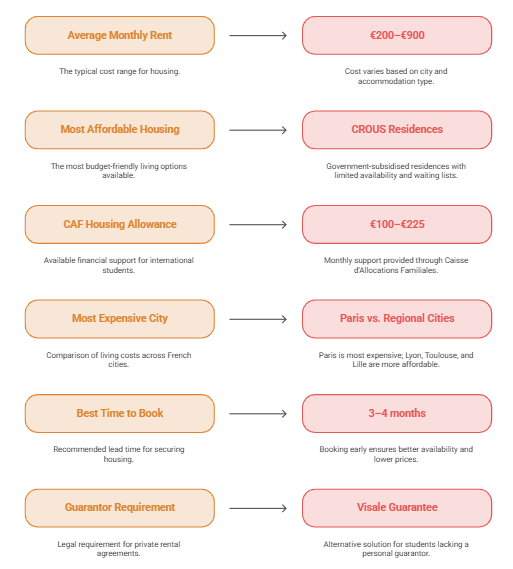
Understanding these key facts will help you choose the right student accommodation, budget effectively and avoid common challenges when renting in France as an international student.
Types of Student Accommodation in France
CROUS Residences (Public University Housing) - run by the French government, offers the most affordable option for students. Rooms are basic: a bed, desk, small kitchenette and shared or private bathroom, but the rent is unbeatable. The catch is that demand is huge and seats often go to French and EU students first, so international applicants need to apply the moment the portal opens. If you miss the main application window, keep an eye on the July Complementary Phase, when CROUS releases the leftover rooms specifically to international students who didn't get a seat in the first round.
Private Student Residences - These are purpose-built buildings for students, run by private companies. They come furnished, often include Wi-Fi, laundry and common study areas and are usually located close to universities. Rent is higher than at CROUS, but the application process is much simpler and doesn't require a French guarantor in most cases.
Shared Apartments (Colocation) - Popular among Indian and international students who want to split rent and cook together. A colocation means sharing a flat with 2–4 other students. It's a good middle ground between cost and independence, though you'll need to coordinate leases and bills with flatmates.
Studio Apartments (Independent Rental) - A private studio gives you full independence but comes at a higher price and usually demands a French guarantor, proof of income and a longer lease. This route suits students who prefer privacy or are moving with family.
Homestays - Living with a French family is less common but available in some cities. It's a good option for students who want to practise French daily and ease into the culture, though it offers the least flexibility.
Cost of Student Accommodation in France
Rent varies sharply based on the city, room type and whether utilities are included. Here's a realistic monthly breakdown for 2026:
|
Accommodation Type |
Average Monthly Rent (EUR) |
Average Monthly Rent (INR approx.) |
|
CROUS Residence |
€200 – €450 |
₹18,000 – ₹40,000 |
|
Private Student Residence |
€500 – €900 |
₹45,000 – ₹80,000 |
|
Shared Apartment (per person) |
€350 – €600 |
₹31,000 – ₹54,000 |
|
Studio Apartment |
€600 – €1,100 |
₹54,000 – ₹98,000 |
|
Homestay |
€450 – €700 |
₹40,000 – ₹62,000 |
Beyond rent, budget for a security deposit (usually one month's rent), agency fees if you use a private agent and basic utilities like electricity, water and internet if they aren't already bundled in. This is a big part of your overall cost of living planning, so it's worth working out your full monthly budget for rent, food, transport and insurance before you finalise a city or university.
City-wise Rent Comparison in France
Where you study makes a bigger difference to your budget than almost anything else. Here's how average rent compares across popular student cities:
|
City |
Average Monthly Rent (Single Room) |
|
Paris |
€700 – €1,100 |
|
Lyon |
€450 – €650 |
|
Toulouse |
€400 – €600 |
|
Lille |
€380 – €550 |
|
Bordeaux |
€420 – €600 |
|
Nantes |
€400 – €580 |
|
Strasbourg |
€400 – €600 |
|
Montpellier |
€380 – €550 |
Paris obviously offers the widest range of universities and internship opportunities, but the rent alone can eat up half your monthly budget. Cities like Lille, Nantes and Montpellier offer strong universities at a much gentler cost, which is why many Indian students now prefer these over the capital.
On-Campus vs Off-Campus Accommodation
On-campus or CROUS housing wins on affordability and proximity to classes, but rooms are small and the allotment process is competitive, especially for international applicants who apply later in the cycle. Off-campus housing, private residences, shared flats, or studios give you more choice in location, room size and lifestyle, but usually cost more and may require a guarantor.
For first-year students, CROUS or a private student residence is generally the safer starting point. It's furnished, comes with support staff and removes the stress of negotiating leases in a new country. Once you're settled and know the city, moving into a shared apartment for your second year is common and often cheaper in the long run.
How to Find Student Accommodation in France
- Apply to CROUS early - through the Trouver un Logement portal as soon as your university confirms admission.
- Check with your university's international office - many partner with private residences and offer reserved quotas for incoming international students.
- Use trusted housing platforms - such as Studapart, Lokaviz and La Carte des Colocs, which are built specifically for student rentals in France.
- Join Indian student groups on Facebook and WhatsApp for the city you're moving to. Genuine listings and warnings about scams often circulate there first.
- Book through an education consultancy - if you want the accommodation search bundled with your admission and visa process, so everything is verified and sorted before you land.
Starting your search the moment your offer letter arrives, rather than after your visa is approved, gives you a real shot at the better-located, better-priced rooms.
Documents Required to Rent Accommodation in France
Landlords and residences in France are fairly document-heavy compared to what Indian students may be used to. Typical requirements include:
- Valid passport and French student visa (or visa appointment confirmation)
- Proof of university admission (acceptance letter)
- Proof of financial means (bank statement or scholarship letter)
- A French guarantor, or enrolment in the Visale guarantee scheme (free for eligible students)
- Passport-size photographs
- Proof of home insurance (Assurance Habitation)
- Completed rental application form (dossier)
If you don't have a French guarantor, Visale is a government-backed guarantee that many private landlords accept and it's genuinely worth applying for before you start house-hunting.
CAF Housing Allowance (APL & ALS) for International Students
One thing many students overlook is that international students in France, including Indians, are eligible for a monthly housing allowance from CAF once they've moved in and set up a French bank account. There are two main types:
- APL (Aide Personnalisée au Logement) - applies mostly to CROUS and conventioned private residences
- ALS (Allocation de Logement Social) - applies to most other rentals, including private studios and shared flats
The amount depends on your rent, city and room type, but many students receive between €100 and €225 per month back. You'll need your lease agreement, French bank account (RIB) and your VLS-TS Visa Validation Certificate to apply and it usually takes a few weeks to process after arrival. It's a genuinely useful refund, so don't skip the application just because the paperwork feels tedious.
When Should You Book Student Accommodation in France?
Timing matters more than most students realise. Here's a rough timeline that works well for the September and January intakes:
- 5–6 months before departure: While preparing for your IELTS exam and university applications, start researching CROUS eligibility and shortlisting cities
- 4–5 months before departure: Start applying for CROUS housing and shortlisting private residences
- 2–3 months before departure: Confirm your room, pay the deposit and apply for Visale if needed
- 1 month before departure: Finalise move-in dates and get your rental contract signed
- On arrival: Complete the move-in inspection and start your CAF application immediately
Booking early isn't just about securing a room; prices for well-located student residences tend to rise as the intake date approaches, so early bookings often lock in lower rent too. Missed the early CROUS deadline? Don't panic, the July Complementary Phase opens up remaining CROUS rooms to international students, so it's worth checking the portal again before you settle for a pricier private option.
Common Rental Scams and How to Avoid Them
Rental fraud targeting international students is unfortunately common, especially on generic classifieds websites. Watch out for:
- Landlords are asking for a deposit or advance rent before a video call or virtual tour
- Listings with unusually low rent for a prime location
- Refusal to provide a proper lease agreement or a French address
- Requests to pay directly via international wire transfer without any documentation
Always verify listings through your university, a known student housing platform, or a consultancy that can confirm the property is genuine before you send any money. If something feels rushed or too good to be true, it usually is.
Tips to Save Money on Student Accommodation in France
Smart budgeting and early planning can significantly reduce your housing expenses, allowing you to enjoy comfortable accommodation without stretching your student budget.
- Apply for CROUS housing the day applications open, don't wait until the deadline
- Consider cities outside Paris where rent is 30–40% lower for a similar standard of living
- Look for shared apartments once you've made friends on campus
- Apply for CAF as soon as you're eligible; don't leave money on the table
- Choose residences that include utilities and Wi-Fi in the rent to avoid surprise bills
- Cook at home rather than relying on eating out, especially in the first few months
Planning your accommodation budget alongside your overall study costs, tuition, insurance and living expenses, makes it much easier to apply for a study abroad scholarship or education loan with an accurate figure, rather than guessing later.
Conclusion
Finding the right student accommodation in France doesn't have to be stressful once you know the timeline and the paperwork involved. Start your CROUS application early, keep the July Complementary Phase in mind as a backup and don't skip your CAF application once you're settled in, as that refund adds up over the year. Whether you end up in a cosy CROUS room or a shared flat with fellow students, getting your housing sorted before you land takes a lot of pressure off your first few weeks in a new country.
If all of this feels like a lot to handle alone, you don't have to. From shortlisting the right university and preparing your education visa to guiding you through accommodation and CAF paperwork, WTS Study Abroad Consultant works with Indian students at every stage of the journey to France, so you can focus on settling in rather than sorting through forms.