



If you're planning to study or work in France, one of the first questions you'll have is: what is the average salary in France? In 2026, the average monthly salary in France is around €2,700–€3,000 net, although earnings vary depending on your profession, experience, qualifications and the city you work in. Understanding these figures is essential for planning your education, career and finances before moving abroad.
If you're an Indian student, salary is only part of the picture. You'll also want to know whether your income can comfortably cover rent, groceries, transport and other living expenses while helping you repay education costs. This guide explains the average salary in France by industry, city and experience level, highlights the highest-paying jobs, compares salaries with the cost of living and converts key figures into INR to help you make an informed decision. We'll also discuss how study in France, choosing the right course and securing scholarships can influence your long-term earning potential.

What is the Average Salary in France?
First-time job seekers in France are often caught off guard by the gap between what's written on a contract and what actually lands in the bank account. Your contract will always quote the salaire brut (gross) but France's social security system, which funds healthcare, pension and unemployment cover, automatically deducts roughly 22–25% before you see a euro. On top of that, France runs prélèvement à la source (pay-as-you-earn tax), so income tax is also deducted monthly rather than settled as a lump sum at year-end, which, frankly, makes budgeting easier once you're used to it.
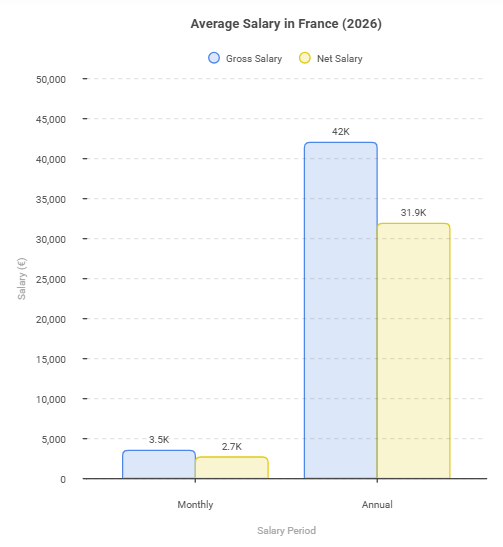
Here's how the average salary in France breaks down at a glance:
|
Metric |
Gross (Brut) |
Net (Take-Home) |
Approx. INR (₹96/€) |
|
Monthly Salary |
€3,500 |
€2,600 – €2,730 |
₹2.5 – 2.6 Lakh |
|
Annual Salary |
€42,000 |
€31,000 – €32,760 |
₹30 – 31.5 Lakh |
Always ask recruiters for the net figure when comparing offers. A "gross" number on paper can look far more impressive than what actually reaches your account each month.
Average Salary in France by Industry
Your field of study is the single biggest factor deciding your starting paycheck. Sectors facing skill shortages give you far more room to negotiate. Here's the quick breakdown:
IT & Technology (AI, Cloud, Cybersecurity): The highest-paying sector for international tech grads. Entry-level developers start at €35,000–€42,000; senior ML engineers scale past €65,000.
Healthcare Doctors and specialists earn well above the national average, though foreign graduates need extra licensing steps to practise. Nurses and allied health roles average €28,000–€35,000.
Engineering (Aerospace, Automotive, Green Energy) Highly prestigious thanks to the Grandes Écoles system. Fresh engineering graduates typically start at €35,000–€40,000.
Finance & Consulting Centred around Paris (La Défense). Junior analysts start near €38,000; financial directors easily cross €75,000.
Digital Marketing & E-Commerce: A more saturated market. Freshers typically sit between €28,000 and €32,000, rising with specialised skills in analytics.
Hospitality & Tourism Management Entry roles often trend close to the SMIC (minimum wage), though luxury hospitality management can scale sharply after 3–5 years.
Check your university's career office for the latest placement data rather than relying purely on published averages. IT, healthcare and renewable energy are currently the fastest-growing sectors.
Highest Paying Jobs in France
The table below highlights some of the highest-paying jobs in France, along with their average annual salaries and the industries driving the strongest demand.
|
Job Role |
Average Annual Salary (Gross) |
Approx. Monthly (Gross) |
|
AI / Machine Learning Engineer |
€58,000 – €75,000 |
€4,800 – €6,250 |
|
Finance Director / CFO |
€70,000 – €95,000 |
€5,800 – €7,900 |
|
Cybersecurity Specialist |
€50,000 – €65,000 |
€4,150 – €5,400 |
|
Aerospace Engineer |
€48,000 – €60,000 |
€4,000 – €5,000 |
|
Data Scientist |
€45,000 – €58,000 |
€3,750 – €4,800 |
|
Management Consultant |
€45,000 – €60,000 |
€3,750 – €5,000 |
|
Pharmacist |
€40,000 – €52,000 |
€3,300 – €4,300 |
|
Civil Engineer |
€35,000 – €45,000 |
€2,900 – €3,750 |
These figures represent gross annual pay for experienced professionals and can vary depending on the employer, region and negotiation.
Average Salary in France by Experience Level
Experience is the single biggest lever for salary growth in France, arguably more so than in India. Salaries follow a fairly predictable climb:
- Entry-Level / Freshers (0–2 Years) - Starting €28,000 – €35,000 gross annually. Heavily influenced by your university's ranking and your spoken French.
- Early Career (2–5 Years) - The Growth Phase €35,000 – €45,000. Your track record from internships (stages) or your first full-time role now matters more than your degree.
- Mid-Career / Management (5–10 Years) - The Leadership Track €45,000 – €58,000, rising further once you take on team leadership or direct project ownership.
- Senior & C-Suite Professionals (10+ Years) - The Expert Tier €65,000 – €90,000+, often topped up with performance bonuses, profit-sharing (intéressement) and equity.
Average Salary in Major French Cities
Where you work changes your paycheck significantly. Paris commands a clear premium, but that comes bundled with a much steeper cost of living.
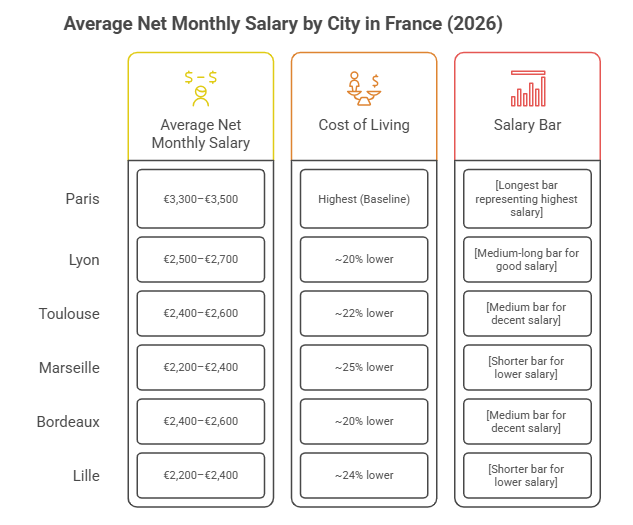
Smaller cities like Lille and Toulouse are often better value for international students starting their careers, since lower rent tends to offset the slightly smaller paycheck. Lyon, in particular, has become a popular choice among Indian graduates because it combines a strong job market in engineering and pharma with rents that are noticeably gentler on a fresher's budget than anything in central Paris.
Minimum Wage vs Average Salary in France
The SMIC (Salaire Minimum Interprofessionnel de Croissance), France's legal minimum wage, was revised in January 2026:
- Hourly gross minimum wage: €12.02
- Monthly gross (35-hour week): €1,823.03
- Monthly net take-home: ~€1,443.11
Compare that to the national average net salary of around €2,600 and the gap is substantial; average earners take home nearly 80% more than someone on minimum wage. This gap widens further in high-skill sectors like IT and finance, which is exactly why choosing the right specialisation before you apply for your education visa can meaningfully change your earning trajectory after graduation.
Salary After Studying in France
This is usually the most-searched part of any France salary guide, so let's get straight to it.
MBA salary: Graduates from top French business schools (HEC Paris, ESSEC, INSEAD) can expect starting salaries of €50,000–€65,000, with graduates from mid-tier programs typically starting closer to €38,000–€45,000.
MS (Master's) salary: Master's graduates in engineering, data science, or business typically start between €32,000 and €42,000, depending on the specialisation and university ranking.
Engineering salary: Graduates from Grandes Écoles (top engineering schools) often command a premium, starting at €38,000–€45,000, notably higher than that of general university engineering graduates.
International student salaries: Here's the honest answer to one of the most common questions we get the average salary in France for international students, including Indian graduates, typically falls between €28,000 and €38,000 in the first job, slightly below the national average for freshers due to language requirements and work-permit formalities.
How Language Scores & Your Post-Study Visa Actually Affect Your Paycheck
This is the part most guides skip and it's the part that changes your real number the most:
- The French language premium: If you speak only English, your job search stays confined largely to multinational corporate headquarters in Paris. Reaching a B2 level in French roughly triples your available job openings. It can lift your starting salary leverage by 10–15%, since employers factor language ability directly into offer levels. A strong IELTS exam score helps at the admissions stage. Still, French fluency is what moves the salary needle after graduation.
- The APS post-study work visa rule: France offers a generous post-study pathway, the Autorisation Provisoire de Séjour (APS), now issued as a Carte de Séjour "Recherche d'emploi / Création d'entreprise." It lets Master's and university graduates stay for up to one year to find a job matching their qualifications. The number that actually matters: to convert automatically into a full work permit, your job offer must pay at least 1.5x the SMIC, roughly €2,734 gross per month. Job offers below this threshold require additional employer-sponsorship steps, so it's worth keeping this figure in mind when negotiating.
- The Alternance route: Landing an Alternance (work-study placement) during your Master's means a company covers your tuition and pays you a monthly stipend while you study. It's widely considered the single highest-converting route to a strong salary offer immediately after graduation, since you're already a known quantity to the employer by the time you're hired full-time.
Is the Average Salary Enough to Cover Living Costs?
Here's where the numbers meet reality. Below is a rough monthly budget comparison for a single international student or fresher living in a mid-sized French city versus Paris.
|
Expense Category |
Paris (Monthly) |
Other Cities (Monthly) |
|
Rent (1BHK/shared) |
€900 – €1,200 |
€500 – €700 |
|
Groceries & Food |
€300 – €400 |
€250 – €320 |
|
Transport |
€75 – €90 |
€40 – €60 |
|
Utilities & Internet |
€120 – €150 |
€90 – €120 |
|
Health Insurance |
€30 – €50 |
€30 – €50 |
|
Leisure & Miscellaneous |
€150 – €250 |
€100 – €180 |
|
Total |
€1,575 – €2,140 |
€1,010 – €1,430 |
Against an average net salary of €2,600 in Paris or €2,300–€2,500 elsewhere, most freshers can cover expenses comfortably and still save a modest amount, provided rent is kept in check. This is exactly why understanding the real cost of living before choosing your city matters as much as the job offer itself.
Tips to Increase Your Salary in France
Follow these practical strategies to improve your earning potential and secure a higher-than-average salary in France after graduation.
- Learn French seriously. Even B1-level conversational French opens doors that remain closed to English-only applicants, particularly outside Paris.
- Target in-demand sectors. IT, cybersecurity, renewable energy and healthcare are consistently short on skilled talent, which translates directly into stronger salary negotiations.
- Build your network early. Alumni associations, LinkedIn groups and campus placement cells matter far more in France than many students expect.
- Get certified. Recognised certifications in your field cloud platforms, project management, or finance can push your starting offer up by 10–15%.
- Negotiate confidently. French employers generally expect some back-and-forth on the initial offer; accepting the first number on the table often leaves money on the table.
- Pick your city strategically. A slightly lower salary in Lyon or Toulouse can leave you better off financially than a higher Paris offer once rent and daily expenses are factored in.
- Start your job search early. Internships and part-time roles during your course build the local experience and references that push your first full-time offer above the average for freshers.
Applying these tips consistently can help you stand out in the French job market and increase your long-term salary growth.
Conclusion
Understanding the average salary in France is about more than comparing paycheques; it's about making informed decisions for your education and career. Your earning potential will depend on factors such as your degree, industry, work experience, language skills and the city where you choose to work. When combined with a clear understanding of tuition fees, living costs and post-study work opportunities, these salary insights can help you plan your future with confidence.
If you're planning to study in France, starting early gives you the best chance of securing admission, scholarships and better career opportunities after graduation. At WTS Study Abroad Consultant, we help Indian students choose the right universities, prepare strong applications, navigate the student visa process and create a realistic financial plan for studying abroad. With the right guidance and preparation, you can maximise your opportunities and build a successful career in France.
Also Read: