




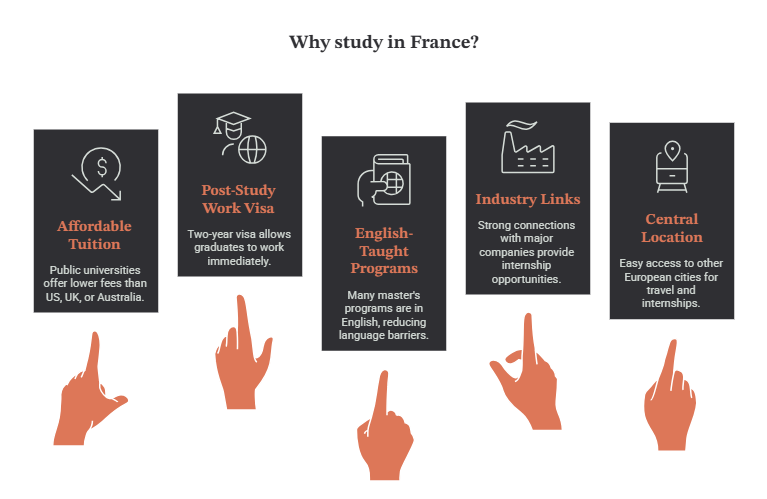
France has quietly become one of the most practical destinations to study in France for Indian students and not just because of the Eiffel Tower on every brochure. Between government-capped tuition at public universities, a two-year post-study work visa and a growing number of English-taught bachelor's and master's programmes, France is now genuinely competitive with the UK, Canada and Germany in terms of affordability, academic quality and career opportunities. If you've been comparing the best universities in France for international students and getting lost in QS rankings, city names and course options, this guide simplifies everything you need to know.
Whether you're planning to study in France for engineering, business, artificial intelligence, or another specialised programme, choosing the right university is the first step towards a successful academic journey. We've curated this list of the best universities in France by considering where Indian students are most likely to secure admission, the tuition fees they can expect, scholarship opportunities, graduate employability and post-study work prospects, not just global rankings. Each university section covers key details, including fees, eligibility criteria, popular courses and what makes it an excellent choice for international students.

Why Study at the Best Universities in France?
France offers something most popular study destinations can't match: low tuition, strong degrees and a real shot at staying back to work.
Top 10 Best Universities in France - Quick Comparison
Here's a quick snapshot before we go university by university. Rankings below are from the QS World University Rankings 2027, the most recent edition available.
|
University |
QS World Ranking 2027 |
City |
Popular Courses |
Average Tuition Fees (per year) |
Acceptance Rate |
|
PSL University |
34 |
Paris |
Sciences, Humanities, Engineering |
€0 – €4,500 |
Highly selective (under 10%) |
|
Institut Polytechnique de Paris |
43 |
Palaiseau (Paris) |
Engineering, Data Science, AI |
€4,000 – €15,000 |
Selective (10–15%) |
|
Sorbonne University |
73 |
Paris |
Medicine, Sciences, Humanities |
€3,770 – €10,000 |
Moderate (25–35%) |
|
Paris-Saclay University |
76 |
Paris (Saclay) |
Engineering, Physics, Life Sciences |
€3,770 – €12,000 |
Moderate (20–30%) |
|
École Normale Supérieure de Lyon |
235 |
Lyon |
Sciences, Humanities, Research |
€0 – €3,770 |
Highly selective |
|
Sciences Po |
354 |
Paris |
Political Science, Law, International Affairs |
€0 – €18,000 (income-based) |
Selective (20%) |
|
Université Paris Cité |
303 |
Paris |
Medicine, Biology, Social Sciences |
€3,770 – €9,000 |
Moderate (30–40%) |
|
Grenoble Alpes University |
387 |
Grenoble |
Engineering, Physics, Computer Science |
€3,770 – €9,500 |
Moderate (35–45%) |
|
University of Montpellier |
473 |
Montpellier |
Medicine, Law, Environmental Science |
€3,770 – €8,500 |
Moderate (35–45%) |
|
University of Strasbourg |
456 |
Strasbourg |
Law, Pharmacy, European Studies |
€3,770 – €8,500 |
Moderate (35–45%) |
Fee ranges vary by programme, level of study and whether a course falls under France's differentiated tuition rules for non-EU students. Always check the official course page for exact figures.
Read More: Best IT Universities in France
Top 10 Best Universities in France – University Profiles
If you're comparing top colleges in France for a specific stream, this section covers each institution's strengths, costs and eligibility in one place, so you can shortlist faster.
1. PSL University (Paris Sciences et Lettres)
PSL is a collegiate university bringing together grandes écoles like École Normale Supérieure, Dauphine and Mines Paris, along with several specialised research institutes. It's the highest-ranked French university worldwide, known for small cohort sizes and access to Nobel laureate faculty; alumni include Marie Curie and Michel Foucault.
|
Detail |
Information |
|
QS World Ranking |
34 |
|
Location |
Paris |
|
Popular Courses |
Physics, Mathematics, Data Science, Humanities, Life Sciences |
|
Annual Tuition Fees |
€0–€4,500 for public-track programmes, higher for select professional masters |
|
Eligibility Criteria |
90%+ in relevant subjects for undergraduate entry, IELTS 6.5+, competitive interviews for select programmes |
2. Institut Polytechnique de Paris
Home to the historic École Polytechnique and four other engineering grandes écoles, IP Paris is the country's top choice for engineering and applied technology, with a campus built specifically for cross-disciplinary research. It ranks 25th globally for employment outcomes, with recruiters like Airbus, Thales and Google hiring directly off campus.
|
Detail |
Information |
|
QS World Ranking |
43 |
|
Location |
Palaiseau, near Paris |
|
Popular Courses |
Engineering, Artificial Intelligence, Data Science, Financial Engineering |
|
Annual Tuition Fees |
€4,000–€15,000 depending on the master's track |
|
Eligibility Criteria |
Engineering or science background, IELTS 6.5/TOEFL 90+, entrance exam or portfolio for some tracks |
3. Sorbonne University
Formed from the 2018 merger of Paris-Sorbonne and Pierre and Marie Curie universities, Sorbonne University is France's biggest name in medicine, science and humanities combined under one roof, with one of the largest international research networks among French universities.
|
Detail |
Information |
|
QS World Ranking |
73 |
|
Location |
Paris |
|
Popular Courses |
Medicine, Biomedical Sciences, Physics, Literature |
|
Annual Tuition Fees |
€3,770–€10,000 |
|
Eligibility Criteria |
Bachelor's degree with 60%+ marks for master's entry, IELTS 6.0+, relevant academic background for medicine and sciences |
4. Paris-Saclay University
Built as a science and engineering powerhouse just outside Paris, Paris-Saclay concentrates a huge share of France's research output in physics, mathematics and biotechnology on a single campus cluster, with tight links to CNRS research labs.
|
Detail |
Information |
|
QS World Ranking |
76 |
|
Location |
Saclay, Paris region |
|
Popular Courses |
Engineering, Physics, Mathematics, Life Sciences, Nuclear Energy |
|
Annual Tuition Fees |
€3,770–€12,000 |
|
Eligibility Criteria |
Strong STEM background, minimum 60% aggregate for master's programmes, IELTS 6.0–6.5 |
5. École Normale Supérieure de Lyon
A smaller, research-intensive grande école known for producing academics and researchers rather than corporate recruits, ENS Lyon is ideal for students planning a PhD or academic career, with direct mentorship from active researchers and one of the lowest costs on this list.
|
Detail |
Information |
|
QS World Ranking |
235 |
|
Location |
Lyon |
|
Popular Courses |
Mathematics, Physics, Computer Science, Philosophy, Linguistics |
|
Annual Tuition Fees |
€0–€3,770 for public-track programmes |
|
Eligibility Criteria |
Excellent academic record, research aptitude, IELTS 6.0+, competitive selection process |
6. Sciences Po
France's leading school for political science, law and international relations, Sciences Po runs a distinctive income-based tuition model and draws one of the most international student bodies in the country, with strong placement records in diplomacy, consulting and public policy.
|
Detail |
Information |
|
QS World Ranking |
354 |
|
Location |
Paris (with regional campuses) |
|
Popular Courses |
Political Science, International Affairs, Law, Economics |
|
Annual Tuition Fees |
€0–€18,000, calculated on family income |
|
Eligibility Criteria |
Strong academic and extracurricular profile, IELTS 6.5+, personal statement and interview |
7. Université Paris Cité
Formed from the merger of several Paris research institutions, Paris Cité is a heavyweight in medicine, biology and social sciences with a large, diverse international student community and deep hospital and research partnerships across Paris.
|
Detail |
Information |
|
QS World Ranking |
303 |
|
Location |
Paris |
|
Popular Courses |
Medicine, Pharmacy, Biology, Social Sciences |
|
Annual Tuition Fees |
€3,770–€9,000 |
|
Eligibility Criteria |
Relevant bachelor's degree, 55–60% aggregate, IELTS 6.0+, entrance test for medical programmes |
8. Grenoble Alpes University
Set in a city known as much for its ski slopes as its tech industry, Grenoble Alpes blends strong engineering and physics departments with a genuinely affordable cost of living and sits at the heart of a major semiconductor and nanotechnology research cluster.
|
Detail |
Information |
|
QS World Ranking |
387 |
|
Location |
Grenoble |
|
Popular Courses |
Engineering, Computer Science, Physics, Nanotechnology |
|
Annual Tuition Fees |
€3,770–€9,500 |
|
Eligibility Criteria |
STEM background preferred, 55%+ aggregate, IELTS 6.0+ |
9. University of Montpellier
One of the oldest universities in the world, dating back to 1289, Montpellier still runs the country's oldest continuously operating medical school alongside strong programmes in law and environmental science, on the Mediterranean coast with a low cost of living.
|
Detail |
Information |
|
QS World Ranking |
473 |
|
Location |
Montpellier |
|
Popular Courses |
Medicine, Law, Environmental Science, Agronomy |
|
Annual Tuition Fees |
€3,770–€8,500 |
|
Eligibility Criteria |
Relevant academic background, 55%+ aggregate, IELTS 6.0+ |
10. University of Strasbourg
Positioned right at the France–Germany border, Strasbourg is a natural fit for students interested in European studies, law, or pharmacy, with easy access to EU institutions like the Council of Europe and European Parliament, headquartered in the same city.
|
Detail |
Information |
|
QS World Ranking |
456 |
|
Location |
Strasbourg |
|
Popular Courses |
Law, Pharmacy, European Studies, Chemistry |
|
Annual Tuition Fees |
€3,770–€8,500 |
|
Eligibility Criteria |
Relevant bachelor's degree, 55%+ aggregate, IELTS 6.0+ |
Best Universities in France by Course
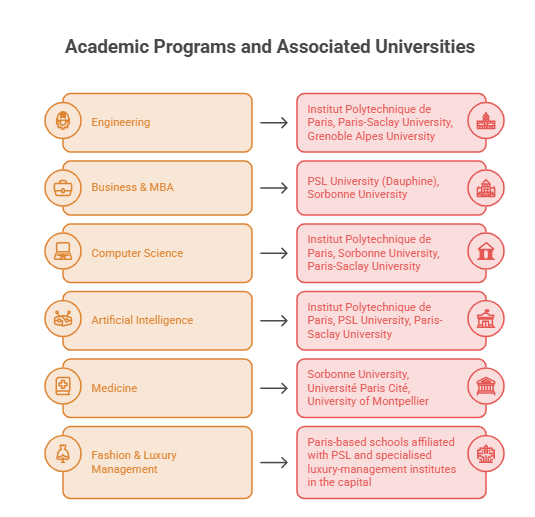
Different institutions lead in different fields, so shortlisting by subject often works better than shortlisting by overall rank alone.
Admission Requirements for French Universities
Requirements shift slightly by programme, but most Indian applicants need:
- Academic transcripts from Class 12 and an undergraduate degree (for master's applicants)
- IELTS or TOEFL scores for English-taught programmes; DELF/DALF for French-medium courses
- Statement of Purpose and 2–3 Letters of Recommendation
- Updated CV, valid passport and passport-size photographs
- Proof of funds to cover tuition and living costs
- Entrance exam or interview for select grandes écoles and medical programmes
Since visa timelines and academic intakes don't always align, start your education visa paperwork as soon as you receive a conditional offer rather than waiting for final admission.
Tuition Fees at the Best Universities in France
Public universities in France follow government-set tuition brackets for non-EU students, roughly €2,770 a year for a Licence (bachelor's) and €3,770 for a Master's, though many programmes reduce or waive this through exemptions and scholarships. Grandes écoles and business-school tracks charge separately, ranging from €4,000 to €18,000 a year depending on the school. Budget €8,000–€12,000 annually for accommodation, food, transport and health insurance, with Paris running noticeably higher than cities like Lille, Strasbourg, or Montpellier. Comparing the cost of living across cities before you shortlist a campus can save a fair amount over a two-year master's.
Scholarships for International Students
France funds a genuinely wide spread of scholarships for Indian students, so tuition rarely has to be paid entirely out of pocket:
- Eiffel Excellence Scholarship – covers monthly stipend, travel and insurance for top-ranking master's and PhD applicants
- Charpak Scholarship – specifically for Indian students, covering partial tuition and living costs
- Institution-specific merit scholarships – offered directly by universities like PSL, Sciences Po and Paris-Saclay
- Erasmus+ funding – for students enrolled in joint European programmes
- Regional council grants – smaller, location-specific grants tied to certain French regions
Applying early matters here, as most study abroad scholarship deadlines fall months before the actual admission deadline and late applications rarely get considered.
Read More: France Scholarships for Indian Students
How to Apply to Universities in France
Applying to the best universities in France is straightforward if you plan your application well in advance and complete each step carefully.
- Shortlist programmes based on course, city, budget and career goals rather than ranking alone.
- Check eligibility for each university, including academic percentage cut-offs and language test requirements.
- Take your IELTS exam or an equivalent English test well in advance, since scores take time to be processed and some intakes fill up early.
- Prepare your SOP, LORs and CV, tailoring each to the specific programme rather than reusing one generic draft.
- Apply through Campus France or Parcoursup/Mon Master, depending on the level of study.
- Apply for scholarships alongside your admission application, not after receiving an offer.
- Secure your offer letter, then begin your student visa and pre-departure documentation.
Starting your application early improves your chances of securing admission, scholarships and enough time to complete your France student visa process before your chosen intake.
Conclusion
Picking from the best universities in France isn't just about matching a QS number to a course name; it's about knowing which programmes accept Indian transcripts without extra bridging courses, which cities fit your budget and which scholarships you actually qualify for. From PSL and Institut Polytechnique de Paris at the top of the rankings to more affordable, research-strong options like Grenoble Alpes and Strasbourg, France genuinely has a fit for most academic goals and budgets. The final decision usually comes down to course strength, city cost of living and how well your profile matches each university's entry criteria, not the ranking number alone.
If France is on your shortlist, getting expert eyes on your profile early makes the process smoother. WTS Study Abroad Consultant can help with shortlisting universities, preparing SOPs, guiding the education visa process and prepping for the IELTS exam, so nothing gets left to guesswork.