




Planning to study in Canada? The first question almost every parent and student asks is simple: what is the actual cost of studying in Canada? Between tuition fees, accommodation, groceries, transportation and visa expenses, the numbers can feel scattered across multiple websites. This guide brings everything together in one place—from tuition fees by degree and city-wise living costs to one-time pre-departure expenses and practical ways to reduce your overall budget without compromising on the quality of your education.
Study in Canada continues to be one of the top choices for Indian students due to its affordable tuition fees compared to countries like the USA, the UK and Australia, excellent post-study work opportunities and welcoming multicultural environment. Whether you're comparing universities, exploring scholarships, preparing for your IELTS exam, or applying for a Canada student visa, understanding the cost of studying in Canada in advance helps you plan your finances with confidence. In this guide, we'll break down the complete study in Canada expenses for 2026, covering tuition fees, living costs and budgeting tips for Indian students.

Cost of Studying in Canada
Understanding the total cost of studying in Canada is the first step in planning your education abroad. The overall expense depends on factors such as your course, university, city and lifestyle, but the estimate below provides a realistic budget for Indian students.
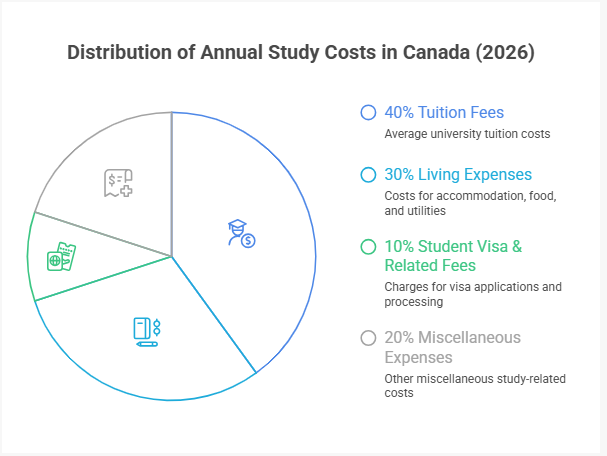
These figures shift depending on your city, course and university ranking, but they give you a realistic starting point for budgeting your first year.
How Much Does It Cost to Study in Canada?
The overall cost of education in Canada is made up of two large chunks tuition and living costs plus a set of smaller one-time expenses before departure. On average, international undergraduate tuition in Canadian universities works out to roughly CAD 41,700 a year, while graduate-level tuition averages around CAD 24,000 a year, according to Government of Canada data. Add another CAD 12,000–20,000 for accommodation, food and daily expenses and your total annual spend for undergraduate study typically lands between CAD 27,000 and CAD 60,000+, while a master's degree usually costs somewhat less.
For Indian families converting this into rupees, a UG program can mean an annual outlay of INR 16–35 Lakhs and a PG program roughly INR 12–28 Lakhs, depending on the university and province. Diploma and PG diploma programs from colleges remain the most budget-friendly route, often coming in under CAD 20,000 a year in tuition. This is one reason so many Indian students exploring cost of studying abroad for Indian students in Canada shortlist college diplomas as a practical, shorter and more affordable pathway into the Canadian job market.
Tuition Fees in Canada by Study Level
Tuition varies sharply by degree type and specialization. Here's a realistic annual range for 2026 intakes:
|
Study Level |
Annual Tuition Fee (CAD) |
Annual Tuition Fee (INR approx.) |
|
Bachelor's Degree |
15,000 – 45,000 |
9 L – 27.5 L |
|
Master's Degree |
14,000 – 40,000 |
8.5 L – 24.4 L |
|
MBA |
25,000 – 65,000 |
15 L – 40 L |
|
PG Diploma/Diploma |
14,000 – 22,000 |
8.5 L – 13.4 L |
|
PhD |
7,000 – 16,000 |
4.3 L – 9.8 L |
PhD candidates often pay the least because many Canadian universities offer research assistantships and tuition waivers to doctoral scholars, making it the most economical route for those pursuing research-focused careers.
Read More: Canada Intakes 2026
Cost of Studying in Canada by Popular Courses
The cost of studying in Canada varies depending on your chosen course, with professional and specialised programmes generally having higher tuition fees than diploma or hospitality programmes.
|
Course |
Average Annual Tuition Fees (CAD) |
Average Annual Tuition Fees (INR*) |
|
Engineering |
CAD 25,000 – 45,000 |
₹15 – ₹27 lakh |
|
Computer Science |
CAD 25,000 – 45,000 |
₹15 – ₹27 lakh |
|
Business |
CAD 20,000 – 40,000 |
₹12 – ₹24 lakh |
|
Data Science |
CAD 20,000 – 40,000 |
₹12 – ₹24 lakh |
|
Nursing |
CAD 18,000 – 30,000 |
₹11 – ₹18 lakh |
|
Medicine (Postgraduate) |
CAD 50,000+ |
₹30 lakh+ |
|
Hospitality Management |
CAD 15,000 – 25,000 |
₹9 – ₹15 lakh |
Engineering, Computer Science and postgraduate Medicine are among the most expensive programmes, while Hospitality Management and Nursing are generally more affordable options for international students. Tuition fees may vary depending on the university and programme.
Cost of Studying at Top Universities in Canada
Tuition fees at Canada's leading universities differ by institution and programme, so comparing costs alongside rankings can help you choose the best value for your budget.
|
University |
QS World Ranking 2026 |
MBA Fees (INR) |
Engineering Fees (INR) |
|
University of Toronto |
#29 |
₹19 – ₹47 lakh |
₹35 – ₹41 lakh |
|
McGill University |
#27 |
₹14 – ₹60 lakh |
₹16 – ₹40 lakh |
|
University of British Columbia |
#40 |
₹6 – ₹43 lakh |
₹25 – ₹35 lakh |
|
University of Alberta |
#94 |
₹5 – ₹18 lakh |
₹17 – ₹26 lakh |
|
University of Waterloo |
#119 |
₹13 – ₹42 lakh |
₹26 – ₹42 lakh |
|
Western University |
#151 |
₹9 – ₹77 lakh |
₹22 – ₹36 lakh |
Universities such as the University of Guelph, the University of Calgary and Simon Fraser University are also excellent options for students seeking quality education with comparatively lower study expenses in Canada.
Cost of Living in Canada for Indian Students
Beyond tuition, your monthly living budget typically breaks down like this:
- Accommodation: CAD 700–1,500/month (shared apartment to studio)
- Food & groceries: CAD 300–500/month
- Local transportation: CAD 90–150/month (student transit pass)
- Utilities (electricity, water, heating): CAD 100–150/month
- Internet & mobile: CAD 60–100/month
- Personal expenses & entertainment: CAD 150–300/month
On-campus residences usually bundle some of these costs together, while off-campus shared housing gives you more control over spending. Most students find that keeping a monthly budget and tracking the cost of living in their specific city early on prevents the mid-semester money crunch that catches so many first-year students off guard.
City-wise Cost of Living in Canada
Where you study changes your monthly budget significantly. Here's a rough monthly comparison (rent + food + local travel):
- Toronto: CAD 1,500–2,200 - highest cost, best job market
- Vancouver: CAD 1,400–2,000 - expensive rent, strong tech and hospitality scene
- Montreal: CAD 1,000–1,500 - lower cost of living, bilingual advantage
- Ottawa: CAD 1,100–1,600 - government and tech hub, moderate rent
- Calgary: CAD 1,000–1,500 - no provincial sales tax, growing job market
- Edmonton: CAD 900–1,400 - among the most affordable major cities
- Winnipeg: CAD 850–1,300 - budget-friendly, smaller student community
- Halifax: CAD 900–1,400 - coastal city, moderate living costs
Students who pick Tier-2 cities like Winnipeg or Edmonton over Toronto or Vancouver often cut their annual living costs by 25–35% without compromising on education quality.
One-Time Expenses Before Moving to Canada
Before travelling to Canada, you'll need to budget for several one-time expenses in addition to your tuition fees. Planning for these upfront costs will help you avoid financial stress and ensure a smooth transition to your new academic journey.
|
One-Time Expense |
Approx. Cost (CAD) |
|
IELTS/PTE Exam Fee |
220 – 320 |
|
University Application Fees |
100 – 250 per university |
|
Student Visa (Study Permit) Fee |
150 |
|
Biometrics Fee |
85 |
|
Medical Examination |
100 – 300 |
|
Airfare (one-way, India–Canada) |
900 – 1,600 |
|
Guaranteed Investment Certificate (GIC) |
approx. 22,895 |
|
Health Insurance (first year) |
600 – 900 |
The GIC is usually the largest single upfront cost since it's meant to cover a full year of living expenses upfront as proof of funds and it's later released to the student in monthly installments once they arrive.
Scholarships & Financial Aid to Reduce the Cost of Studying in Canada
Scholarships can meaningfully bring down your overall cost of higher education in Canada. Options include:
- Government-funded scholarships such as the Vanier Canada Graduate Scholarships and provincial international student awards
- University-specific scholarships, including entrance scholarships, merit-based tuition waivers and dean's awards offered directly by institutions like UBC, McGill and the University of Manitoba
- External and third-party scholarships from foundations and trusts supporting Indian students studying abroad
To improve your odds, apply early, maintain a strong academic record and don't rely on a single scholarship application. A well-planned study abroad scholarship search, combined with early applications, can shave several lakhs off your total spend.
Can International Students Work While Studying in Canada?
Yes. International students on a valid study permit can generally work part-time during academic sessions and full-time during scheduled breaks, subject to current IRCC rules. Average student wages range from CAD 16 to CAD 22 per hour depending on the province and job type.
Working around 20 hours a week during term can bring in roughly CAD 1,300–1,700 a month, which comfortably covers rent and groceries for many students, easing pressure on funds sent from home. Campus jobs, retail, food service and tutoring remain the most accessible options for first-semester students still building local work experience.
Tips to Reduce the Cost of Studying in Canada
Managing your finances wisely can significantly reduce the overall cost of studying in Canada without compromising your education or student experience.
- Shortlist universities in Tier-2 cities where tuition and rent are both lower
- Apply for scholarships and tuition waivers well before deadlines
- Opt for shared accommodation instead of studio apartments in your first year
- Use student discounts on transit, software and entertainment
- Cook at home and limit dining out to occasional treats
- Take up part-time campus work once your permit allows it
- Compare currency conversion rates before large transfers to avoid losing money on forex margins
By following these practical budgeting tips, you can lower your study and living expenses in Canada while making the most of your time as an international student.
Conclusion
Studying in Canada is an investment in your education, career and future. While the overall cost of studying in Canada varies depending on your university, course and city, careful financial planning can make the journey much more affordable. By understanding tuition fees, living expenses, visa costs, scholarships and part-time work opportunities, you can create a realistic budget and avoid unexpected expenses during your studies.
If you're planning to study in Canada and need expert guidance, WTS Study Abroad Consultant is here to help. From university shortlisting and scholarship assistance to visa documentation and pre-departure support, our experienced counsellors provide end-to-end guidance tailored to your goals and budget. Get in touch with WTS Study Abroad Consultant today and take the first step towards achieving your dream of studying in Canada with confidence.