


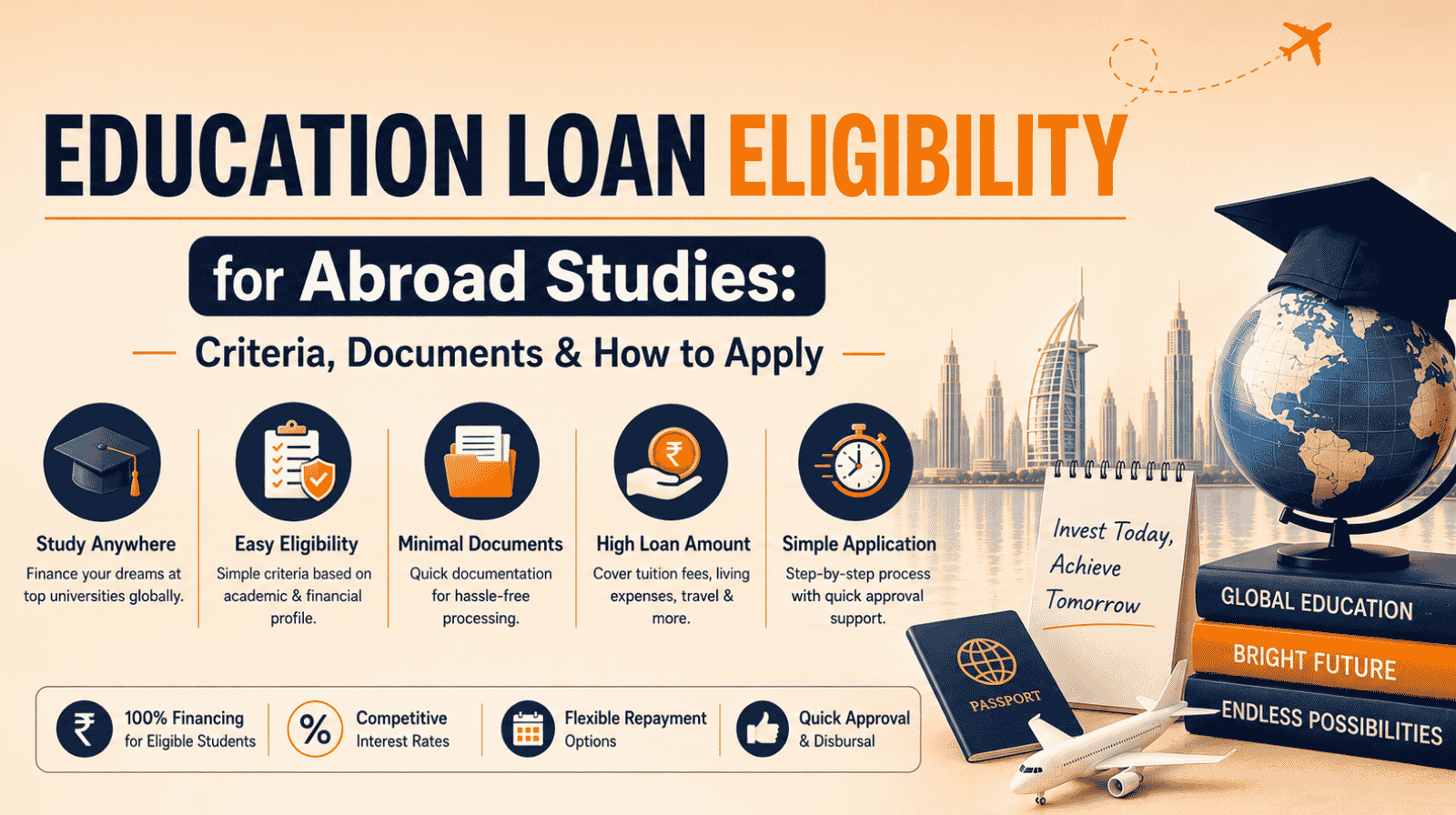
What is an Education Loan?
An education loan is a financial product offered by banks, non-banking financial companies (NBFCs) and government institutions to help students fund their higher education both in India and abroad. It covers a wide range of expenses, including tuition fees, accommodation, travel, books, laptops and other course-related costs.
For students dreaming of an international degree, an education loan for study abroad acts as a lifeline. It enables you to attend globally recognized institutions without depleting your family's savings.
Education loans come in two broad types:
- Secured loans require collateral such as property or fixed deposits. These typically offer higher loan amounts and lower interest rates.
- Unsecured loans need no collateral but are usually capped at a lower amount and may carry higher interest rates.
Repayment usually begins after a moratorium period typically the course duration plus 6 to 12 months giving students time to secure employment before EMIs kick in.

Benefits of Education Loan for Studies Abroad
Opting for a student loan for studying abroad brings far more advantages than just financial support. An education loan can make studying abroad more accessible by covering tuition fees, living expenses, travel costs and other educational expenses. It reduces the financial burden on students and families while allowing students to focus on achieving their academic and career goals without compromising on quality education. Here's why thousands of Indian students choose this route every year:
Full Financial Coverage: Education loans typically cover tuition fees, examination fees, hostel charges, travel expenses, books and equipment making it a one-stop financial solution.
Tax Benefits: Under Section 80E of the Income Tax Act, the interest paid on an education loan is fully deductible for up to 8 years, resulting in substantial tax savings.
No Collateral for Smaller Amounts: Many banks offer unsecured loans up to ₹7.5 lakh without requiring any security ideal for short-term courses or certificate programs.
Moratorium Period: Most lenders offer a repayment holiday during your course period plus 6–12 months, so you can focus on studies and job hunting without financial pressure.
Builds Credit History: Repaying your loan on time helps you build a strong credit profile from a young age, benefiting you for all future financial needs.
Multiple Currency Options: Lenders disburse funds directly in foreign currency or through SWIFT transfer to the university, simplifying international fee payments.
Education Loan Eligibility Requirements
Before applying, it is essential to understand the education loan eligibility criteria set by most lenders. While specific requirements vary between banks and NBFCs, the general framework looks like this:
|
Eligibility Parameter |
Details |
|
Nationality |
Must be an Indian citizen. Some lenders also consider NRIs under special schemes. |
|
Age |
Between 18 and 35 years at the time of application. |
|
Academic Background |
Admission to a recognized foreign university; minimum 50%–60% in last qualifying exam. |
|
Co-applicant |
Parent, guardian, or spouse mandatory; their income and credit history are evaluated. |
|
Admission Proof |
Confirmed admission letter from the university is required. |
|
Course Type |
Recognized degree, diploma, or certificate from an accredited institution (MBA, MS, MBBS, Engineering, etc.). |
|
Credit History (CIBIL Score) |
Co-applicant's CIBIL score should ideally be 700 or above for strong student loan eligibility. |
|
Collateral |
Required for loans above ₹7.5 lakh immovable property, life insurance policies, or government bonds. |
Meeting these eligibility parameters does not guarantee approval, but it significantly strengthens your application. If you fall short on any one criterion such as CIBIL score or collateral consider exploring NBFCs or government-backed schemes like the Vidya Lakshmi Portal, which often have more flexible study loan eligibility norms compared to traditional banks.
Documents Required for an Education Loan for Abroad
To apply for an education loan for abroad studies, students must submit essential documents such as admission letters, academic records, identity proof, income documents and financial statements. Having complete and accurate documentation can help speed up the loan approval process and improve the chances of securing funding for international education.
|
Category |
Documents Required |
|
Student Identity & Age Proof |
PAN card, Aadhaar card, passport, birth certificate or 10th marksheet |
|
Student Academic Records |
10th, 12th and undergraduate marksheets; degree certificates |
|
Student Entrance Exams |
GRE, GMAT, IELTS, TOEFL scorecards |
|
Student Admission Proof |
Confirmed offer letter / admission letter from the foreign university |
|
Student Visa |
Valid passport and education visa (some banks process before visa grant) |
|
Co-applicant Identity |
PAN card and Aadhaar card |
|
Co-applicant Income Proof |
Latest salary slips (3–6 months), Form 16, or IT returns (last 2–3 years) |
|
Co-applicant Bank Statements |
Last 6–12 months bank statements |
|
Co-applicant Employment Proof |
Employment certificate or business registration proof (if self-employed) |
|
Collateral (Secured Loans) |
Title deed of property, valuation report from certified valuator, encumbrance certificate |
Having all these documents ready before you approach a lender saves significant time and reduces the chances of rejection due to incomplete paperwork. It is advisable to keep both original and self-attested photocopies of every document. For students who have already received their education visa, submitting it alongside the loan application can further speed up the disbursement process.
How to Apply for an Education Loan for Abroad from India
Applying for an education loan for abroad studies from India involves selecting a suitable lender, checking eligibility criteria, submitting the required documents and completing the loan application process. Understanding each step can help students secure financial support smoothly and focus on achieving their international education goals.
Step 1 Research and Compare Lenders: Start by comparing public sector banks (SBI, Bank of Baroda, PNB), private banks (HDFC, Axis, ICICI) and NBFCs (Avanse, Auxilo, InCred) based on interest rates, maximum loan amount, processing fees and repayment terms.
Step 2 Check Your Eligibility: Use online education loan eligibility calculators available on most lender websites to get a preliminary estimate of how much you can borrow.
Step 3 Collect Documents: Gather all required documents from both the student and co-applicant academic records, income documents, admission papers and identity proofs.
Step 4 Submit Your Application: Apply online through the lender's official website or visit the nearest branch. The Vidya Lakshmi Portal aggregates multiple lenders for easy comparison and application.
Step 5 Loan Processing and Verification: The bank will verify your documents, assess the co-applicant's financial profile and evaluate the collateral if applicable. This typically takes 7 to 30 working days.
Step 6 Loan Sanction and Agreement: Upon approval, you receive a sanction letter. Read all terms carefully before signing.
Step 7 Education Visa Application: Many embassies require a loan sanction letter as proof of funds during your education visa application. Once the visa is granted, submit a copy to the bank.
Step 8 Disbursement: The loan amount is transferred directly to the university or your international bank account in the required foreign currency, as per the university's fee schedule.
Who Should Apply for a Student Loan for Abroad Studies?
A student loan for studying abroad is not just for those who cannot afford education outright. It is a smart financial move for:
- Merit-based students who have earned admission to top-ranked universities and want to manage costs efficiently without burdening their families
- First-generation learners from middle-income families who have the capability but lack sufficient savings
- Students pursuing high-ROI courses such as MBA, MS in Computer Science, Data Science, or Medicine, where post-graduation salaries comfortably justify the loan
- Families with limited liquid assets but with stable income or property that can serve as collateral
- Scholarship holders who need to cover the portion of fees not funded by their scholarship
- Students who want to preserve family savings for other financial goals like retirement or property purchase
If you fall into any of these categories and hold a genuine admission from a recognized foreign university, you are a strong candidate to explore study loan eligibility across multiple lenders.
Why Should You Opt for a WTS Education Loan?
Choosing the right lending partner is just as important as choosing the right university. WTS Education Loan is designed specifically for Indian students who aspire to study abroad, offering a seamless and student-friendly borrowing experience from application to disbursement.
Here's why students trust WTS for their education loan for study abroad:
- Get funding up to ₹1.5 crore to cover tuition, living and all study-related expenses at top global universities.
- Enjoy some of the most affordable interest rates in the market, keeping your long-term repayment burden.
- Quick turnaround time ensures your loan is sanctioned well before your education visa appointment.
- Full transparency in fees, processing charges and repayment terms, no surprises down the line.
- Repayment tenures of up to 15 years with an extended moratorium period so you can focus on your career.
- End-to-end guidance from loan experts who help you at every stage from eligibility check to final.
- Whether you're heading to the US, UK, Canada, Australia, Germany, or Ireland WTS has you covered.
If you are serious about studying abroad and want a lender who understands the unique needs of international students, partnering with WTS Study Abroad Consultants can help you navigate the process with confidence. From shortlisting the right institution to securing the right education loan, you have a smart, reliable choice every step of the way.
Conclusion :-
Securing an education loan for studying abroad can transform your academic aspirations into reality without putting undue financial pressure on your family. Understanding education loan eligibility, having the right documents ready and choosing the right lender are the three pillars of a smooth loan journey.
Remember to compare multiple lenders, factor in interest rates and repayment terms and apply well in advance of your education visa appointment to avoid last-minute stress. Whether you're checking your student loan eligibility for a Master's program in the US or a professional certification in Europe, the right loan product is out there waiting for you.
Start your research today and take that first confident step toward your global education journey. And all it takes is one well-informed financial decision to set everything in motion.