



Did you ever wonder which is the hardest degree in the world? If you think it is just Medicine or Engineering, think again. Several degrees can test your patience, skills and dedication every single day. Some are packed with difficult subjects, while others demand years of practical training, endless assignments and sleepless nights.
So, which degree is the toughest? The truth is, there is not a single winner. Medicine is often considered the hardest degree in the world because of its long duration, vast syllabus, practical training and the responsibility of dealing with people's lives. However, degrees like Aerospace Engineering, Architecture, Law, Quantum Physics and Chartered Accountancy are just as demanding in their own ways.
In this guide, we will rank the top 10 hardest degrees in the world, explain what makes each one so challenging and help you understand whether it is the right fit for your career goals. Everything is explained in simple, easy-to-understand language, so you can make an informed decision before choosing your future.
List Top 10 Hardest Degrees in the World
Have you ever wondered why some degrees are considered much tougher than others are easy? It is not just because of difficult exams. The hardest degrees usually involve years of study, complex subjects, practical training, long hours of coursework and a lot of dedication.
There is not an official ranking that decides the hardest degree in the world. The list below is based on factors like course difficulty, study duration, workload, practical training and the opinions of education experts and universities worldwide.
|
Rank |
Degree |
Typical Duration |
Why It's Hard |
|
1 |
Medicine (MBBS/MD) |
5–6 years |
Huge syllabus, hospital training and high-pressure exams |
|
2 |
Aerospace/Aeronautical Engineering |
4 years |
Advanced maths, physics and aircraft design |
|
3 |
Quantum Physics/Theoretical Physics |
4–6 years |
Complex theories, abstract concepts and advanced mathematics |
|
4 |
Law |
3–5 years |
Lots of reading, case studies and strong analytical skills |
|
5 |
Actuarial Science |
3–4 years |
Advanced statistics, probability, and difficult professional exams |
|
6 |
Architecture |
5 years |
Combines creative design with engineering and long project hours |
|
7 |
Pharmacy (PharmD) |
4–6 years |
Chemistry-heavy subjects, clinical training, and drug safety |
|
8 |
Computer Science (AI Specialization) |
4 years |
Programming, algorithms, mathematics, and constantly changing technology |
|
9 |
Chemical Engineering |
4 years |
Mix of chemistry, physics, maths, and industrial process design |
|
10 |
Biomedical Engineering |
4 years |
Combines biology, medicine, and engineering to develop healthcare technologies |
Every degree on this list is challenging in its own way. Some require excellent memory, while others demand strong mathematical skills, creativity or logical thinking. The "hardest" degree also depends on your interests and strengths. A course that feels impossible for one student may be exciting and enjoyable for another.
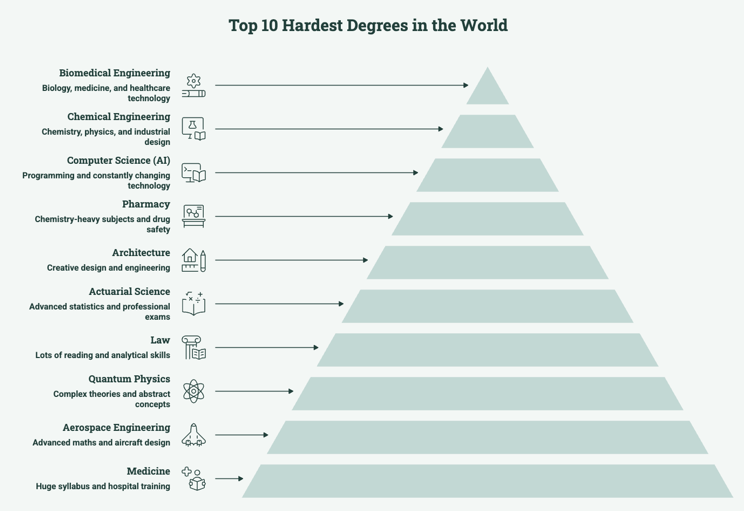
In the next section, we will look at each degree in detail, explain why it is considered one of the toughest in the world and explore the career opportunities it offers after graduation.
Find the Right
University for Your Profile
Get a personalised list of universities based on your marks, budget, course and preferred country.

Overview of the Top 10 Hardest Degrees in the World
Every degree on this list is challenging, but the reason behind its difficulty is different. Some courses require years of practical training, while others test your mathematical skills, logical thinking, creativity or ability to work under pressure. Here is a closer look at what makes these degrees some of the hardest in the world.
1. Medicine (MBBS/MD)
Medicine is widely considered the hardest degree in the world because it combines a huge syllabus with years of practical training and real-life responsibility. Medical students spend years studying anatomy, physiology, pathology, pharmacology and other medical subjects before treating patients during clinical rotations.
In India the journey usually starts with clearing NEET, followed by a 5.5-year MBBS program, internship and often postgraduate specialization through NEET PG. The biggest challenge is not just passing exams but balancing hospital duties, practical training, and continuous learning.
2. Aerospace/Aeronautical Engineering
Aerospace Engineering is one of the toughest engineering degrees because it requires advanced knowledge of mathematics and physics. Students learn how to design aircraft, spacecraft, satellites and defense systems where even a small calculation error can lead to major problems.
The course includes subjects like aerodynamics, propulsion systems, fluid mechanics and structural analysis. It also requires students to use advanced design and simulation software, making it both technically and mentally demanding.
3. Quantum Physics/Theoretical Physics
Quantum Physics is one of the most difficult academic degrees because it focuses on concepts that cannot be seen or experienced in everyday life. Students rely heavily on mathematics to understand how matter and energy behave at the smallest level.
Unlike many science courses, this degree requires abstract thinking, logical reasoning and solving complex mathematical problems instead of memorizing facts. That is why many students find it one of the hardest subjects to master.
4. Law
A Law degree is challenging because it requires students to read large volumes of legal documents, understand complex laws and build strong arguments based on evidence. Success depends more on analytical thinking and reasoning than memorization.
Students study constitutional law, criminal law, corporate law and legal ethics while preparing case studies, legal research and court presentations. Since there is not always one correct answer, students must learn to defend their arguments with confidence.
5. Actuarial Science
Actuarial Science is considered one of the hardest degrees because it combines advanced mathematics, statistics, probability, economics and finance. Students learn how to calculate financial risks for insurance companies, banks, pension funds and investment firms.
What makes this field even more challenging is that earning the degree is only the beginning. To become a qualified actuary, graduates must clear several professional actuarial exams while often working full time. These exams are known for their low pass rates and require years of preparation.
6. Architecture
Architecture is one of the toughest creative degrees because it combines artistic design with engineering and construction knowledge. Students do not just design buildings. they also learn about building materials, structural safety, environmental sustainability and construction methods.
Most architecture students spend long hours creating drawings, digital models, presentations and physical prototypes while working under strict deadlines. Managing creativity and technical accuracy at the same time makes this course especially demanding.
7. Pharmacy (PharmD)
Pharmacy is a challenging healthcare degree because it requires a deep understanding of chemistry, biology, pharmacology and human anatomy. Students learn how medicines are developed, how they work inside the body and how different drugs interact with each other.
The course includes laboratory work, clinical training and patient care, where accuracy is extremely important. Even a small mistake in dosage or medication can affect patient safety, making precision a key part of the profession.
8. Computer Science (Advanced AI Specialization)
Computer Science becomes much more difficult when students specialize in Artificial Intelligence, Machine Learning, Cybersecurity, or Data Science. These fields require strong programming skills along with mathematics, statistics, algorithms, and logical thinking.
Another challenge is that technology changes very quickly. Students must constantly learn new programming languages, software tools, and AI frameworks to keep their skills up to date even after graduation.
9. Chemical Engineering
Chemical Engineering combines chemistry, physics, mathematics and engineering into one highly demanding course. Students learn how to design and improve industrial processes used to manufacture chemicals, medicines, fuels, food products and many everyday items.
The course includes subjects such as thermodynamics, heat transfer, reaction engineering and process design. It requires excellent analytical skills because engineers must ensure that manufacturing processes are efficient, safe and environmentally friendly.
10. Biomedical Engineering
Biomedical Engineering is considered one of the hardest engineering degrees because it combines biology, medicine, and engineering in a single course. Students learn how to design medical devices, artificial organs, prosthetics, diagnostic equipment, and healthcare technologies.
The degree requires knowledge of anatomy, electronics, mechanics, programming, and materials science. Since these technologies directly affect patient health, students must maintain high levels of precision and accuracy throughout their studies. It is an excellent career choice for those interested in both healthcare and engineering.
How to Choose the Right Course
Choosing the hardest degree is not always the smartest decision. The best course for you is one that matches your interests, strengths and long-term career goals. A degree may be difficult, but if you enjoy the subject, you will find it much easier to stay motivated and succeed.
Here are a few things to consider before making your decision:
- Know Your Interests: Choose a course that genuinely interests you. If you enjoy biology, Medicine or Pharmacy might be a good fit. If you love mathematics and problem-solving, Engineering, Actuarial Science or Computer Science could be better choices.
- Understand Your Strengths: Be honest about your skills. Some degrees require strong mathematical ability, while others focus on creativity, communication or analytical thinking. Pick a course that matches what you are naturally good at.
- Research Career Opportunities: Look beyond the degree itself. Find out what jobs you can get after graduation, the average salary, future demand and opportunities to work in different countries.
- Check the Course Structure: Read the syllabus carefully. Some degrees involve internships, laboratory work, clinical training, research projects or studio sessions. Make sure you're comfortable with the workload before applying.
- Consider the Cost: Tuition fees, accommodation, books and living expenses can vary significantly between universities and countries. If you are planning to study abroad, also look for scholarships and financial aid.
- Think About Your Long-Term Goals: Ask yourself where you want to be five or ten years from now. Your degree should help you move toward that goal, whether it is becoming a doctor, engineer, lawyer, researcher or entrepreneur.
- Talk to Experts: Speak with teachers, career counselors, university representatives or professionals already working in your chosen field. Their advice can give you a realistic picture of what to expect.
A highly ranked university can open many doors, but the best university is the one that fits your budget, career goals and learning style. Research your options carefully before making your final decision.

Conclusion
The top 10 hardest degrees in the world are challenging for different reasons. Some require years of practical training, others test your mathematical and analytical skills, while a few demand creativity, research and problem solving. Degrees like Medicine, Aerospace Engineering, Quantum Physics, Law, Actuarial Science, Architecture, Pharmacy, Computer Science, Chemical Engineering and Biomedical Engineering all require dedication, discipline and a genuine interest in the subject.
If you're an Indian student, remember that the journey often begins with choosing the right university and preparing for entrance exams. Instead of selecting a course just because it is popular or has a high salary, choose one that matches your interests, strengths and long-term career goals.
If you are planning to study abroad, take time to compare universities, tuition fees, scholarships and career opportunities. You can also speak with a trusted study abroad consultant to understand which country and university best fit your academic profile and budget. With the right planning and preparation, even the world's toughest degree can become the first step toward a successful and rewarding career.