




Every year, thousands of Indian students choose the September intake because almost every Irish university opens its full range of undergraduate and postgraduate courses during this period.. For Indian students aiming to start studies in 2026, applications are already open or opening soon with deadlines typically running from late 2025 through mid 2026.
In simple words, the September intake offers the widest choice of courses, more scholarships, and better alignment with global academic calendars. If you are an Indian student researching study options abroad, this is often the best time to join because almost every university and program accepts new students then. Many Indian students prefer it for the vibrant campus life and post-study work opportunities in Ireland.
This guide covers everything you need from deadlines and eligibility to costs, visas, and practical tips tailored for Indian applicants. Read on to plan your application effectively and avoid common pitfalls.
Key Takeaways
- September is the main Ireland intake, with maximum course options and scholarships available.
- Typical entry requirements for Indian students include strong academics (60-70%+), English proficiency (IELTS 6.5+) and financial proof of €10,000+ for visa.
- Tuition ranges €10,000–€25,000/yearand living costs €10,000–€20,000/year.
- Post-study work visa (Stamp 1G) allows up to 2 years of stay after graduation.
- Start preparing now for better chances at top universities and funding.
What is the September Ireland Intake?
The September Ireland intake is the primary academic session and it also known as a Autumn intake starting in September each year, offering the broadest range of undergraduate and postgraduate programs across Irish universities.
It aligns with the traditional academic year and attracts the largest number of international students, including many from India. In contrast, the January (Spring) intake is smaller and mostly limited to certain postgraduate courses.
Why Indian Students Prefer the September Intake
- Full availability of programs in fields like Business, Computer Science, Engineering, Data Analytics and Pharmacy.
- More opportunities for campus integration, orientation events and networking.
- Better timing for scholarships and part-time work during the academic year.
Ireland’s education system is globally respected for its research focus, industry partnerships, and welcoming environment for international talent. Understanding intakes is the first step toward building a successful application strategy.
Top Universities & Popular Courses for September Intake & Deadlines 2026
Here is a list of universities that are highly popular among Indian students for their academic excellence, industry connections and strong support services for international students.
|
University |
Global Ranking (QS 2026 Approx.) |
Popular Courses for Indian Students |
Approximate Deadlines for Sept 2026 Intake |
Key Notes & Application Tips for Indian Applicants |
|
Trinity College Dublin (TCD) |
Top 100 |
Business, Computer Science, Law, Data Science, Medicine |
Priority: February 1, 2026 Final: June 30, 2026 |
Highly competitive. Strong SOP and high academics (70%+) recommended. Excellent research facilities and central Dublin location. Application fee ~€55. |
|
University College Dublin (UCD) |
Top 130–150 |
Business Analytics, Engineering, Data Analytics, Finance, AI |
Rolling from Oct 2025 Recommended by May/June 2026 |
Very popular with Indians. Large international community. Offers many merit scholarships. Rolling admissions — apply early for popular programs. Fee ~€60. |
|
University College Cork (UCC) |
Top 250–300 |
Pharmacy, Sustainability, Food Science, Engineering, Business |
Rolling from Oct 2025 Closing: May–June 2026 |
Known for innovation and green campus. Good for STEM and health sciences. Affordable living in Cork compared to Dublin. Strong industry ties. |
|
Dublin City University (DCU) |
Top 400 |
Computing, Business, Digital Media, Engineering, Finance |
Rolling; apply by June/July 2026 |
Modern campus with excellent employability focus. Popular for practical, job-oriented programs. Good scholarship options for Indian students. |
|
University of Limerick (UL) |
Top 400 |
International Business, Engineering, Pharmaceutical Sciences, AI |
Rolling from Oct 2025 Apply early 2026 |
Co-op programs (paid internships) highly beneficial for Indian students seeking work experience. Vibrant campus life. |
|
University of Galway |
Top 250–300 |
Biomedical Engineering, Data Analytics, Business, Marine Science |
Rolling; priority by March–April 2026 |
Culturally rich city with lower living costs. Strong in research and innovation. Welcoming for international students. |
Important Note: The deadlines mentioned are approximate based on 2026 intake patterns. Competitive programs may close earlier. Please check the official application portal of each university for the most accurate and updated information.
Types of Intakes in Ireland
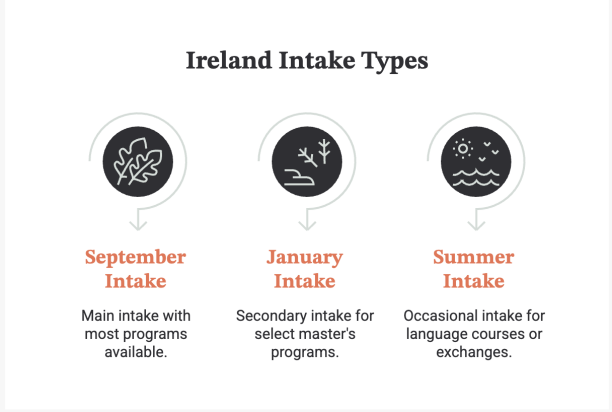
Ireland primarily features two main types of intakes September (Autumn/Fall) intake and January (Spring) intake. Limited options may exist for short-term or foundation programs in summer, but degree-level programs predominantly follow the September-January cycle.
- September (Autumn) Intake: This is the main intake with nearly all undergraduate and postgraduate programs available across public and private institutions.
- January (Spring) Intake: A secondary intake, primarily suited for select master’s and postgraduate diploma programs at specific universities.
- Summer Intake: Occasional and restricted, often for language courses, study abroad exchanges, or short certifications rather than full degrees.
This structure provides flexibility while maintaining academic quality and resource allocation.
Duration of the September Intake in Ireland
The September intake is the main intake in Ireland and usually begins in early September. For most programmes first semester runs from September to December, followed by exams and a break before the second semester starts in January. The full academic year generally ends around May or June, depending on the university and course structure.
Undergraduate programmes in Ireland usually last 3 to 4 years, while taught masters in Ireland generally take 1 to 2 years. Research-based programmes may take longer, depending on the subject and university requirements.
For Indian students, the September intake is often the most suitable option because it offers the widest course choice, full campus activity, orientation support, and enough time to prepare documents, visas, and travel plans before classes begin.
Course duration itself depends on the programme, not the intake:
- Undergraduate degrees: Typically 3–4 years, full-time
- Postgraduate taught master's:Typically 1–2 years, full-time
- PhD programmes: Typically 3–4 years
Eligibility & Requirements Ireland Intake
Requirements Academic: For undergraduate programs, Indian students typically need strong 12th-grade marks (often 65%+ in relevant subjects). For postgraduate (taught master’s) programs, a 4-year Bachelor’s or 3-year with a 2:1 (approx. 60–70%+ marks) is standard. STEM or business courses may have higher requirements. Research (PhD) programs often require a master’s or very high undergrad marks.
English Requirements: Nearly all courses are taught in English. Universities require proof of proficiency via tests. Typical requirements: IELTS Academic 6.5 overall (no band <6.0) or TOEFL iBT 90 (with minimum sectional scores). Some competitive programs (MBA, certain MSc) may require higher scores (e.g. IELTS 7.0). Approved tests include IELTS, TOEFL iBT, PTE (59+), or Cambridge (minimum 180). UCD specifies the IELTS requirement explicitly (6.5 overall, 6.0 each). Students can usually apply before obtaining test results, but final offers are conditional on meeting the score.
Other Requirements: Check if your 12th-grade curriculum is recognized (most Indian boards like CBSE, ISC are acceptable; details may vary by course). Some programs may want prerequisite subjects or work experience (especially MBAs). No entrance exam is needed generally, but GMAT/GRE may be required for some management/PhD programs.
Ireland Intakes 2026 September vs January
September (Autumn) intake is the main and most popular intake, offering the widest range of courses and opportunities. The January (Spring) intake is a secondary option, mainly available for selected postgraduate programs with fewer seats.
Here is a clear comparison to help you decide which intake is better for you:
|
Feature |
September 2026 Intake (Autumn) |
January 2027 Intake (Spring) |
|
Availability |
Almost all undergraduate and postgraduate courses |
Limited – mostly postgraduate programs only |
|
Number of Courses |
Highest choice |
Fewer options |
|
Application Period |
October 2025 – June/July 2026 |
June 2026 – November 2026 |
|
Competition Level |
Higher |
Lower |
|
Scholarships |
Maximum opportunities |
Very limited |
|
Class Size & Campus Life |
Large, vibrant, full orientation & events |
Smaller classes, quieter start |
|
Best For |
Undergraduate students + most postgraduate students |
Students who missed September or need more time |
|
Post-Study Work Timing |
Better alignment with job market |
Slightly delayed graduation timeline |
|
Living & Accommodation |
Easier to find in advance |
May have fewer options available |
Recommendation: If possible, target September 2026. It is the safest and most beneficial intake for the majority of Indian students.
Scholarships for September 2026 Intake
The September 2026 intake offers the highest number of scholarships for Indian students. The most prestigious is the Government of Ireland International Education Scholarship (GOI-IES), along with many university-specific awards.
|
Scholarship Name |
Type |
Benefits |
Eligibility Highlights |
Application Timeline |
|
Government of Ireland (GOI-IES) |
Government |
€10,000 stipend + full/partial tuition waiver |
High academic merit, non-EU students |
Usually Jan – March 2026 |
|
Trinity Global Excellence Scholarship |
University (TCD) |
Up to full tuition reduction |
Excellent academics + strong SOP |
With university application |
|
UCD Global Excellence Scholarship |
University (UCD) |
€5,000 – €10,000 |
Merit-based for Indian students |
Oct 2025 – April 2026 |
|
UCC International Scholarships |
University (UCC) |
€3,000 – €7,000 |
Strong academic record |
With course application |
|
University of Limerick India Scholarships |
University (UL) |
Up to €4,000 |
Merit + leadership qualities |
Rolling |
|
DCU International Merit Award |
University (DCU) |
€1,000 – €5,000 |
Good academics |
With application |
Common Mistakes to Avoid When Applying for Ireland Intake
Planning to study in Ireland for the September intake is an exciting move, but the application process can get overwhelming. Many Indian students miss out on their dream universities not because they aren't qualified, but because of simple, avoidable slips.
Here is a breakdown of the most common mistakes to steer clear of, written in plain English, to help you get your offer letter.
- Applying Too Late: The September intake fills up fast and Irish student visas can take 4 to 8 weeks to process. If you wait too long, you might miss your chance even if a college accepts you.
- Writing a Copy-Paste SOP: Do not just repeat your resume in your Statement of Purpose. Admissions teams want to know exactly why you chose Ireland and how the course fits your future career.
- Ignoring Specific Course Rules: Do not just look at the general university requirements. Always check the specific page for your exact course, as they might ask for specific subject marks or a portfolio.
- Showing Messy Financial Proofs: Visa officers are strict about money. You must show a clear, unbroken bank record proving you have enough funds to cover tuition plus at least €10,000 for living expenses.
- Delaying Your English Test: You cannot get your final visa without your IELTS, TOEFL or PTE scores. Take the test early so you have time to retake it if your score is too low.
- Waiting to Look for Housing: Finding a place to live in cities like Dublin or Cork is highly competitive. Start looking for student housing months before you fly out, not after you land.
- Forgetting Scholarships: Scholarship deadlines often close very early. Do not wait until you get your admission letter apply for scholarships at the same time you apply for your course.
- Overlooking Health Insurance: You are required to have private medical insurance to get your Irish student visa. Make sure this is sorted and included in your paperwork.
Pro-Tip: Connect with a study abroad consultants early on. Having an expert review your paperwork and SOP can save you from these easily avoidable mistakes!
Conclusion
Choosing the right Ireland intake is one of the most important decisions when planning to study abroad. For most Indian students, the September 2026 intake is the best choice because it offers the widest selection of courses, more scholarship opportunities, a vibrant campus experience and better internship and career prospects.
By understanding the application timeline, eligibility requirements, and admission process well in advance, you can avoid unnecessary stress and submit a stronger application. Start preparing as early as possible by shortlisting universities, gathering the required documents, improving your English language test score and applying before the deadlines.
With proper planning and the right guidance, you can secure admission to one of Ireland’s leading universities and take the first step toward a successful international education and career.