


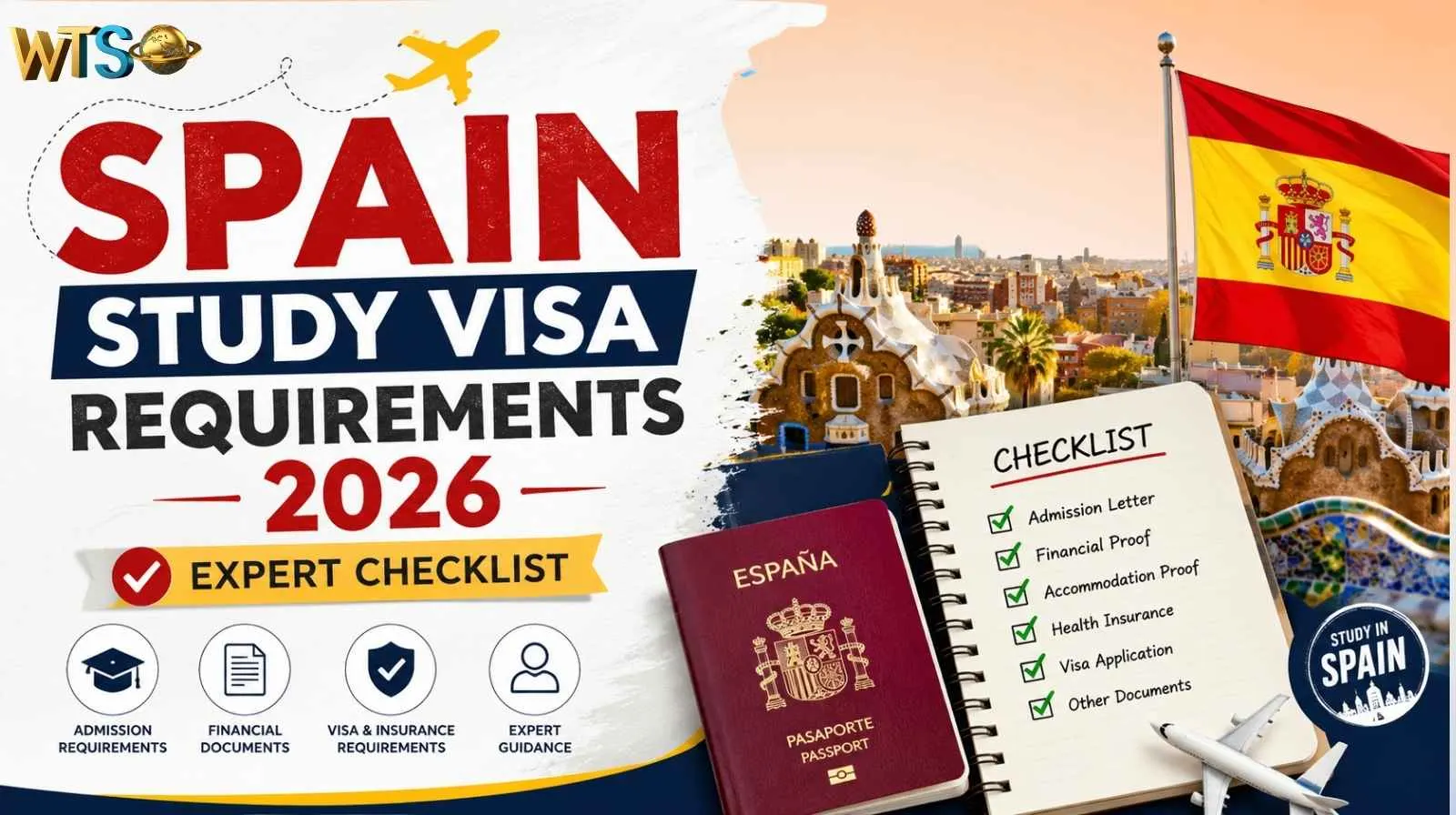

Spain has updated its student visa policy, and very few sources online have been able to update their information accordingly. The Royal Decree 1155/2024 has become enforceable from May 2025, which has changed the qualifications, what needs to be proven by every document, and what needs to be done in 30 days upon arrival. Fail one condition and the consulate will return your application in its entirety. Fail to comply with the conditions upon arrival and you will lose your right of legal residence. The following is a list of all 2026 Spain study visa requirements for citizens of non-EU states wishing to stay longer than 90 days.
Do You Actually Need This Visa?
Travellers for a period up to 90 days do not need a student long-stay visa. If a short-stay Schengen visa is applicable based on nationality, it goes through another process.
- The long-stay student visa applies to non-EU/EEA citizens who want to:
- Pursue higher education in an accredited Spanish institution, which grants a degree.
- Study post-compulsory secondary education such as Baccalaureate and Intermediate Vocational Training.
- Participate in student mobility programs.
- Volunteer for officially recognised non-profit organisations.
- Carry out specific training: language assistantship under the NALCAP program, Spanish language courses at Cervantes-accredited centres, and vocational training in authorised teaching centres.
- Major changes after 2025 reforms: it becomes impossible for foreign minors to get a student visa for compulsory education purposes. According to Art. 52 RD 1155/2024, the student visa is applicable for higher education or non-compulsory secondary level studies only.
Course type defines your visa application process, work and family visa eligibility. A Spanish language course in a private academy and the same course at a university language department are completely different courses according to this regulation. This creates an essential difference and impacts the student's right to work.
The 2026 Core Documents Checklist
Every applicant submits these documents, regardless of course type or length of stay. Understanding these Spain study visa requirements can also improve the Spain study visa success rate study in Spain.
Conditional acceptance letters, those offering a place subject to unmet conditions, are not accepted. Enrolment must be confirmed before submission.
Financial Proof: The 2026 IPREM Thresholds
There are benchmarks for financial Spain study visa requirements against the IPREM (Indicador Público de Renta de Efectos Múltiples). According to the Spanish Ministry of Foreign Affairs, the official 2026 monthly minimums are:
Calculation is done for the exact duration of intended stay rather than an automatic 12-month period. For a programme that takes six months, there should be six months of money, although the one month before the course commencement and the fifteen days after the course end are part of the validity period of the visa according to the 2025 regulation. In case of pre-payment of accommodation costs fully supported by documentation, then the cost will be deducted from the total monthly amount required.
Proof of finances:
- Last three bank statements for the applicant in his/her name and with sufficient closing balance. Bank statements in English do not require translation in most consulates.
- Scholarship/financial aid award letter.
- Notarised sponsorship letter from the parents/guardians including their last three bank statements and notarised copies of their identity card and the student’s birth certificate.
Personal savings are accepted fully without any requirement of proof of continuous income like the other Spanish long-stay visa.
Health Insurance: The Silent Failure of Visa Applications
Spain travel insurance is not eligible. It is required to have:
- Insurance issued by a company authorised in Spain. A public register can be found at rrpp.dgsfp.mineco.es (Ministry of Economy and Business).
- Coverage for all risks provided by Spain's public health service throughout the entire duration of stay, including the buffer periods before and after the course.
- No co-payments, no deductibles, and no grace periods on specific benefits.
- If there is a monetary limit on coverage, it has to be at least €30,000.
- It is also required from volunteers to provide their organisation's civil liability insurance policy.
Medical Certificate & Criminal Record: Most Common Checklist Mistakes
Medical Certificate
Most guides claim that the medical certificate requirement is only for long-stay applicants. This is false. All applicants regardless of how long they are staying in Spain have to submit an original medical certificate stating that they are free of any disease with serious public health repercussions according to the International Health Regulations 2005.
The medical certificate should:
- Have been issued no more than three months prior to the application date.
- Have the stamp of the issuing centre, the name, signature, license number, and issuing date of the doctor.
- Signed by a licensed physician. Neither nurse practitioners nor physician assistants are acceptable signatories.
- Be either on official headed paper or the bilingual form provided by the consulate. In case of an English-only medical certificate, a certified Spanish translation is needed.
Certificate of Criminal Record
All applicants aged 18 years or older who have a total stay duration greater than 180 days should provide a criminal record from the country of residence, as well as from all countries where he or she resided for more than six months during the last five years.
This certificate should:
- Be issued no later than six months prior to the submission.
- Have the Hague Apostille certification mark. For countries not participating in the Hague Convention the alternative form of legalisation will be done by means of the Spanish consulate in that country.
- Be accompanied by a translated Spanish version made by a sworn MAEC translator.
- Be presented in an original plus copy format. Any certificates that have been modified, damaged, or unfastened will not be considered.
How and When to Apply?
The application period begins six months before the course starts and ends two months before the course start date. Apply on time, because the consular process includes consultations with the Spanish authorities and cannot be fast-tracked once applied. Applicants seeking an education visa should ensure every document is complete before booking their appointment.
After your completed application gets accepted by the consular department, internal processing in Spain takes up to seven working days since the file enters the central visa system (not the day of the submission to the visa centre). Plan to give a minimum of five weeks from the submission to the visa collection date. Do not purchase the tickets till you receive your visa.
Submission should be done personally, by appointment, to the Spanish consulate or appointed visa application centre in the jurisdiction of the applicant. Universities in the jurisdiction of the Spanish consulate are able to submit the collective applications on behalf of enrolled students providing an official letter with identification of each student and authorised representative.
Steps After Arrival That Most Applicants Fail to Follow
Getting the visa sticker does not mean the procedure is finished. For programmes lasting longer than 180 days, two additional steps must be performed in the first 30 days after arrival in Spain.
Step 1: Empadronamiento (Municipal Registration)
It is necessary to register your place of residence at the local ayuntamiento. It serves to fix your place of residence in Spain and should be done prior to applying for a TIE card.
Step 2: TIE Card (Tarjeta de Identidad de Extranjero)
In case you are staying more than 180 days, a visa sticker will serve just as an entry document that is valid for up to a year. You have to make a police appointment at the local Oficina de Extranjería and apply for a TIE card within 30 days after arrival. TIE proves lawful residence and it will be valid during the entire period of study.
NIE (Número de Identidad de Extranjero) is an ID number provided by the Spanish police. It is indicated on the TIE card, but it does not prove the residence. NIE will be requested from banks, landlords and public institutions, but they usually want a TIE card.
Work Authorisation and Family Visas: Changes Made in 2025
Students attending higher education programmes receive automatic work authorisation for up to 30 hours a week. Students of non-superior programmes, for example, language academies, are required to obtain work authorisation separately and may not be eligible. Studying the same language course at the language department of a university will change the type of visa and give work rights.
Only students studying in higher education or specialised healthcare programmes can bring their families with them under the student family visa programme. Family members who may join under the student family visa are: a spouse or registered partner; an unregistered partner with at least one year of relationship or common children; minor children below 18 years; and adult children having some kind of support needs due to their disabilities or illness.
Family visa applications can be considered only after the approval of the student visa application. All documents proving the relationship between the applicant and the family members should have a Hague Apostille and sworn translation into Spanish. Many applicants also choose to work with a study abroad consultant to ensure these supporting documents are prepared correctly. It is prohibited for the family members to work.
Common Reasons Applications Are Refused
- Insufficient financial documentation not meeting the IPREM criteria for the entire duration of the stay, including buffer days prior and after the course.
- Insurance policy having copayments, deductibles, grace periods, or coverage limit lower than €30,000.
- Medical report issued by a nurse practitioner and not a qualified doctor.
- Criminal background check without the Hague Apostille or an authorised Spanish translation.
- Conditionally accepted letters instead of enrolled confirmation letters.
- Mismatch between names, dates or addresses on any documents.
- Submission outside the time period of the application process.
- Missing information on the application form or failure to submit the necessary disclaimer form.
Application rejection can be contested. An appeal can be filed in Spanish at the issuing consulate within one month from receiving the written decision. An appeal before the High Court of Justice of Madrid may be made within two months of notice.
Conclusion
Most rejection cases have nothing to do with eligibility. This is about the medical certificate issued by someone else, about the insurance contract that includes a deductible of €200 in the seventh clause, about missing the 15-day period after the language course from the equation. Consulates do not explain why one makes mistakes; they reject and restart the process.
Spain has introduced some amendments in 2025. All guides that were published before May of that year give the wrong information concerning work permit, bringing the family, and the necessity of having the medical certificate. Reading such an outdated list confidently is the costliest error in this application process.
Submit your paperwork well ahead of time, make sure all your documents are exactly as described above and do not schedule anything nonrefundable until you have the visa in your hands. Students living in Barcelona, Madrid, and Seville have done exactly this.