



Every year, lakhs of Indian students pack their bags for London, Manchester, Birmingham and Edinburgh, chasing degrees from universities that consistently rank among the world's best. But before any of that excitement kicks in, there's one hurdle every applicant has to clear first the visa. And if you've started researching UK Study Visa Requirements, you already know how fast the rules seem to shift from one year to the next. The good news? For 2026, the process is fairly predictable once you know exactly what UKVI (UK Visas and Immigration) is looking for.
This guide breaks down the entire UK student visa from India journey in plain language who qualifies, what documents you'll need, how much money you must show, the fees involved and the timeline you should plan around. Whether you're still narrowing down universities, researching a study abroad scholarship, prepping for your IELTS exam, or trying to work out the real cost of living once you land, this is the one page you'll want bookmarked through your entire application.

What Are the UK Study Visa Requirements?
At its core, the UK Study Visa Requirements for 2026 boil down to five things: a confirmed place at a licensed UK institution, proof that you can afford your course and stay, evidence of your English language ability, a clean immigration history and a genuine intention to study (not just a plan to work or settle).
The visa itself is officially called the Student Route visa and it replaced the old Tier 4 system a few years back. It's now fully digital you won't get a physical sticker or card. Instead, you receive an eVisa linked to your UKVI online account, which you'll use at immigration checkpoints and to prove your status to landlords, employers and banks once you're in the UK.
Before diving into paperwork, it helps to understand that the Home Office isn't just checking boxes. Caseworkers are trained to spot inconsistencies a mismatch between your academic history and your chosen course, or bank statements that look "arranged" rather than genuine. Understanding this mindset early saves you from silly, avoidable rejections later.
Who Is Eligible for a UK Student Visa?
Not everyone can apply and the eligibility bar is fairly specific. To begin with, you must be at least 16 years old at the time of application and you need an unconditional offer along with a Confirmation of Acceptance for Studies (CAS) from a licensed student sponsor that's your university or college. Alongside this, you have to prove your English language ability, usually through an IELTS exam score, though some universities accept their own internal tests or count a prior UK qualification as sufficient on its own.
Money matters just as much as academics here. You must show you can financially support yourself tuition plus living costs for the length of your course, capped at 9 months. On top of this, UKVI expects genuine intent: your application needs to reflect that you actually plan to study and either return home or move to a valid post-study route afterward, rather than using the visa as a backdoor route to permanent settlement. And naturally, a clean immigration history matters too; applicants with prior visa refusals, overstays, or deportation orders may face extra scrutiny or an outright refusal.
Indian students applying under the points-based Student Route typically need 70 points, made up of a valid CAS, financial requirement and English language ability all assessed together rather than as three separate hurdles.
Documents Required for a UK Study Visa
Getting your paperwork right the first time is probably the single biggest factor in a smooth uk student visa application. Missing or inconsistent documents are the number one reason applications get delayed for extra evidence requests. Most Indian applicants need a valid passport, their CAS reference number, passport-sized photographs meeting UK visa specifications, proof of financial funds, English language proficiency proof, academic transcripts referenced in the CAS, a TB test certificate and where applicable an ATAS certificate or parental consent for minors. Here's a quick breakdown:
|
Document |
Mandatory For |
Notes |
|
CAS Number |
All applicants |
Issued by your university within 6 months of course start |
|
Passport |
All applicants |
Must have at least one blank page |
|
Financial Proof |
All applicants (unless exempt) |
Covered in detail in the next section |
|
TB Test Certificate |
All Indian applicants |
From a Home Office-approved clinic in India |
|
IELTS/English Proof |
Most applicants |
Some universities offer exemption letters |
|
ATAS Certificate |
STEM/research courses only |
Check with your university if unsure |
A quick tip: keep both digital and printed copies of everything. UKVI's online system occasionally asks for re-uploads and having files organised in one folder saves you from last-minute panic.
UK Student Visa Financial Requirements (Bank Balance & Proof of Funds)
This is where most applications actually fall apart, so pay close attention. UKVI wants hard proof not estimates that you can cover your tuition and living costs without depending on public funds.
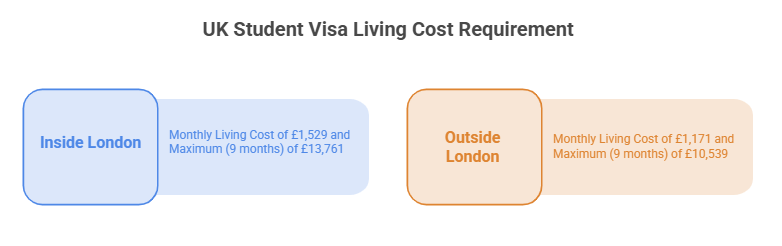
You need to show your remaining course fees, as stated on your CAS, plus a fixed monthly living cost £1,529 per month if your course is in London, capped at £13,761 for 9 months, or £1,171 per month if it's outside London, capped at £10,539 for 9 months.
This entire amount tuition balance plus living costs must sit in your account (or your parent's/sponsor's account, with a consent letter) for 28 consecutive days and the closing date of that 28-day window has to fall within 31 days of your visa application date. If your balance dips even briefly below the required figure during those 28 days, your application can be refused, no exceptions.
Some Indian students are exempt from this financial proof altogether for instance, if you've already held a UK visa for 12 months or more, or if you're covered by an official scholarship or a government/university sponsorship that already accounts for your fees and living costs.
 If you're using an education loan to meet this requirement, make sure the sanction letter is dated correctly, clearly states the loan amount and confirms the funds will be released before your course begins. A well-planned education visa file with clean, traceable finances is genuinely half the battle won.
UK Study Visa Fees and Other Costs in 2026
Beyond tuition and living funds, there are upfront costs tied directly to the visa itself. The standard visa application fee is £558 for applications made from outside the UK and most students also need to pay the Immigration Health Surcharge (IHS) of £776 per year of their visa, paid upfront in one lump sum. Add to that the TB test fee, which usually runs between ₹3,000 and ₹5,000 depending on the clinic and the IELTS or equivalent English test, priced around ₹17,000 to ₹18,500. A priority visa service is also available at most centres for those who want a faster decision, at an extra cost.
|
Cost Component |
Approximate Amount |
|
Visa Application Fee |
£558 |
|
Immigration Health Surcharge |
£776/year |
|
TB Test |
₹3,000–₹5,000 |
|
IELTS/English Test |
₹17,000–₹18,500 |
|
Priority Service (optional) |
Varies by visa centre |
Factor these into your overall budget alongside tuition and cost of living students often underestimate the visa-side expenses and are caught off guard when the total adds up.
How to Apply for a UK Study Visa: Step-by-Step Process
Here's how the uk student visa process typically unfolds for Indian applicants:
- Secure your CAS from your university once you've accepted your offer and paid any required deposit.
- Complete the online application on the official UKVI website, filling in your personal, academic and financial details accurately.
- Pay the visa fee and Immigration Health Surcharge as part of the online form.
- Book and attend your biometric appointment at a Visa Application Centre (VFS Global handles this for Indian applicants) to submit fingerprints and a photograph.
- Upload or submit your supporting documents, including your CAS, financial evidence, TB certificate and passport.
- Wait for a decision, which is communicated through your UKVI account.
- Collect your eVisa details and set up your UKVI online account for travel and future reference.
Double-check every field before submission a mismatched name spelling or an incorrect CAS number can trigger unnecessary delays or a request for further evidence.
Read More: SOP for UK Student Visa
UK Student Visa Processing Time and Application Timeline
The standard uk student visa processing time for applications made from outside the UK is around three weeks. If you're switching or extending your visa from within the UK, it typically takes closer to eight weeks, though a priority service (where offered) can speed this up for an additional fee.
You can submit your application up to six months before your course start date if applying from India and you're generally allowed to enter the UK up to one month before your course begins. Given how much can go wrong with courier delays, document requests, or clinic appointment backlogs for the TB test, applying early gives you a real cushion most consultants recommend starting your visa paperwork the moment your CAS arrives, rather than waiting until the last month.
Common Reasons for UK Student Visa Rejection and How to Avoid Them
Even strong candidates get refused sometimes usually over avoidable technical errors rather than eligibility. The most common one is breaking the 28-day funds rule, where even a single day of the balance dipping below the required threshold can cause refusal. Mismatched or unclear financial documents are another frequent issue bank statements that don't match the name on the passport, or funds sourced from accounts UKVI doesn't recognise, tend to raise red flags immediately.
Other avoidable mistakes include incomplete or expired CAS details, where the course, dates, or fee amounts don't match what's declared in the application; weak or vague evidence of genuine intent during document review; missing or invalid TB test certificates, especially those from non-approved clinics; and gaps in English language proof, such as an IELTS exam score that doesn't meet the required band or missing exemption documentation.
Most of these issues are entirely preventable with careful planning and a second pair of eyes reviewing your file before submission which is exactly where professional guidance tends to make the biggest difference.
Conclusion
Studying in the UK is a genuinely exciting step, but the visa stage is where most of the stress tends to build up not because the rules are unreasonable, but because they're detailed and unforgiving of small mistakes. Getting your paperwork, finances and timelines aligned early is really what separates a smooth application from a stressful one. Keep every document consistent with your CAS, respect the 28-day funds rule to the letter and give yourself enough runway before your intake so that a delayed TB test appointment or a document re-request doesn't throw off your plans.
If you're serious about studying in the UK this intake, start early and don't leave the financial evidence to the last minute. And if you'd rather not navigate the process solo, WTS Study Abroad Consultant is there to guide you through every stage from choosing the right course to filing a clean, complete visa application.